The Philologist and the Betrayer

What the Evangelists Said—and What They Did Not Say
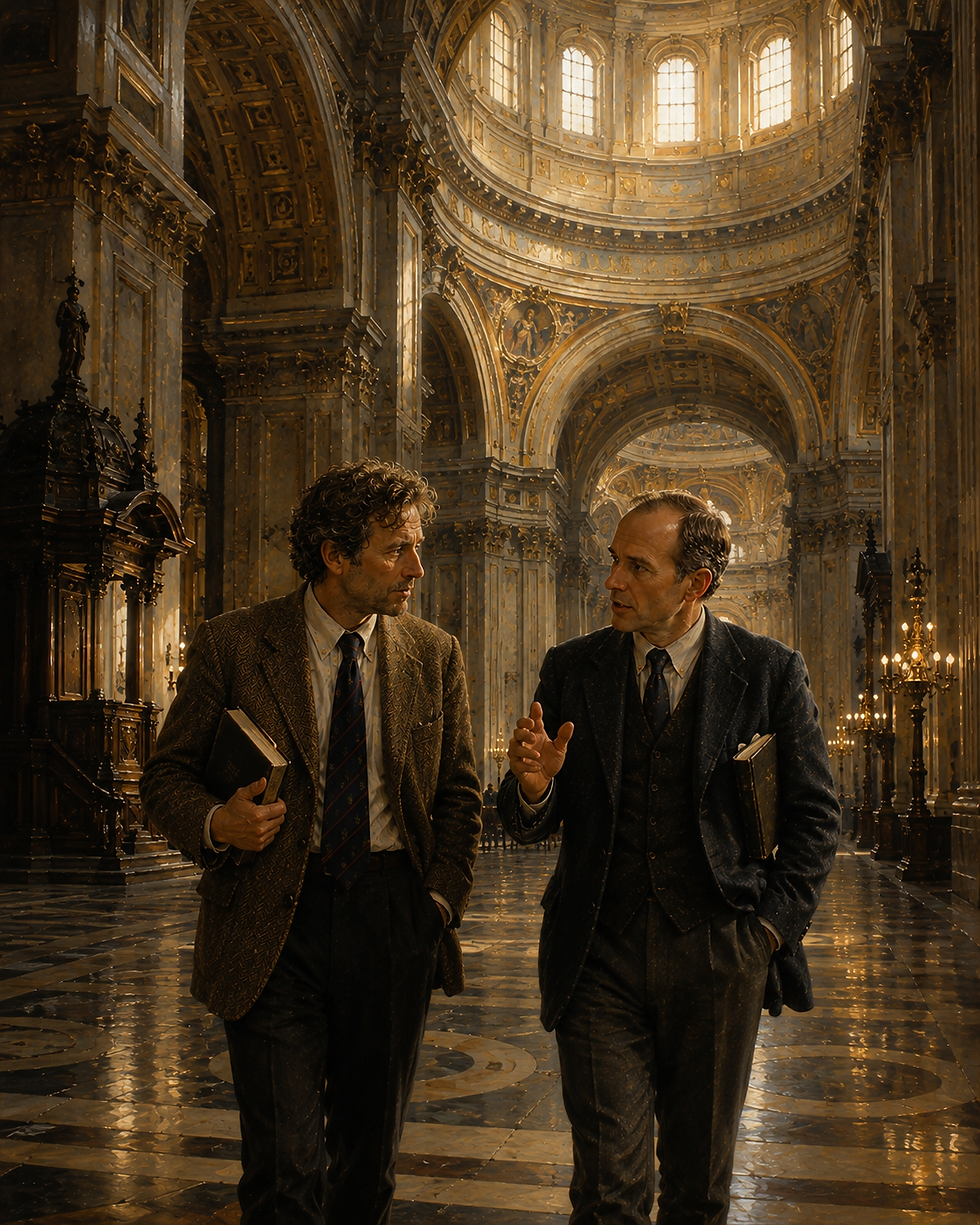
Chapter 1
There are friendships that begin with agreement, and there are friendships that begin with disagreement. I have always found the latter to be the more durable.
I first met Dr. Isaac Oldton in Jerusalem during the spring of 1996. The occasion was an academic conference bearing the magnificently overambitious title Text, Tradition, and Transformation in Late Antiquity. Like many such gatherings, the title promised rather more transformation than was ultimately delivered, but the conversations in the corridors proved infinitely more rewarding than several of the papers read from polished lecterns.
Isaac had been born in Manchester to a Jewish family before emigrating to Israel as a young man. By the time we met he had become one of those enviable scholars who seemed equally at home discussing the Mishnah, Josephus, the Septuagint, or the Church Fathers. He possessed that rarest of academic virtues: he could explain difficult ideas without first making them incomprehensible.
He described himself, with a smile that was never quite ironic, as "a free-thinker."
Ever since that curious afternoon, I have entertained the delightful suspicion that he belongs to that most elusive of fraternities: the Order of the Spheres. No minutes are ever published, no subscriptions collected, and yet one occasionally encounters its members in the most unexpected places.
"I have escaped denominations," he had told me over coffee during the second afternoon of the conference.
"And have you escaped certainty?" I asked.
He laughed.
"No. Only committees."
I liked him immediately.
Our first disagreement, however, had begun several hours earlier, during Isaac's lecture.
His paper examined the final week of Christ's earthly ministry and advanced a thesis that immediately divided the audience. With admirable composure he argued that Jesus had consciously orchestrated the sequence of events leading to His arrest and crucifixion; that the entry into Jerusalem, the preparation of the Upper Room, the timing of the Passover meal, and even the journey to Gethsemane revealed the deliberate hand of a man directing history towards its appointed conclusion. Yet, Isaac suggested, somewhere between purpose and fulfilment something had gone unexpectedly awry. Some human element had escaped the design. Some unforeseen act had altered the course of events.
When the chairman invited questions, I found myself on my feet almost before I had realised I was standing.
You have given us,"I said loudly from the rear part of the salon, "a sequence that is admirably economical."
Oldton inclined his head.
"Economy is often a sign of explanatory strength."
"Or of explanatory selection."
"Dr. Oldton," I began, "you have presented us with a Messiah who appears to have planned everything, and yet whose plan somehow failed. Forgive me, but I cannot decide whether your Christ is too divine to be surprised or too human to succeed."
The lecture theatre became remarkably quiet.
Isaac smiled—not the smile of a man being challenged, but of one who had hoped someone would finally challenge him.
"Then perhaps," he replied, "the failure lies not in Christ's plan but in our assumption that we already understand what His plan was."
It was a magnificent answer.
I nevertheless informed him that I thought he was wrong.
He thanked me afterwards for saying so.
Only theologians and philologists can begin what becomes a lasting friendship by publicly disagreeing before a hundred scholars. It is an absurd way to acquire friends, but I have found it surprisingly reliable.
We corresponded intermittently after Jerusalem. A Christmas card here, an article exchanged there, the occasional note concerning some newly published manuscript or neglected patristic observation. We disagreed often enough to remain interested in one another.
It was therefore a considerable pleasure to receive his letter during the autumn of 1999 informing me that he would be spending several weeks in London researching at the British Library.
"If you are in the vicinity," he wrote in his neat hand, "I shall be delighted to resume our unfinished argument."
He neglected to specify which unfinished argument.
There were dozens.
We arranged to meet beneath the great dome of St. Paul's Cathedral on a damp October afternoon.
No building has ever persuaded me more completely that architecture can be an act of prayer.
Sir Christopher Wren achieved something extraordinary. He designed not merely walls and columns but silence itself. The moment one enters St. Paul's, London seems to remain obediently outside. The traffic continues. The buses continue. Commerce continues. Yet they become distant, as though civilisation itself had agreed to lower its voice.
I arrived rather earlier than our appointed hour.
Old habits die reluctantly. My father had maintained that punctuality was merely good manners measured with a watch. I have seldom discovered a reason to dispute him.
The cathedral was already alive with its peculiar afternoon congregation.
Tourists wandered respectfully without quite understanding why they had lowered their voices.
A verger crossed the nave carrying what appeared to be enough keys to imprison an empire.
Several elderly ladies arranged flowers before the high altar with a concentration usually reserved for neurosurgery.
Near the west door a small boy asked his mother whether kings were buried there.
"Some of them," she replied.
An admirable answer.
The great dome gathered every whisper and returned it softened. Dust floated through shafts of pale London sunlight with almost liturgical dignity. Somewhere in the distance an organist was quietly rehearsing the opening bars of Stanford in C, allowing the chords to drift upwards until they disappeared among Wren's impossible geometry.
I have often believed that England's greatest theological arguments have not taken place inside universities but inside her churches.
Oxford supplies conclusions.
Cathedrals encourage questions.
I was contemplating Sir Joshua Reynolds' memorial when I heard a familiar voice behind me.
"Sir Timothy."
I turned.
"Isaac."
He looked almost precisely as I remembered him from Jerusalem, although his hair had surrendered a little more ground to time. His spectacles remained perched precariously near the end of his nose, lending him the appearance of a man permanently on the verge of discovering something inconvenient.
"It has been too long," he said, extending his hand.
"Entirely my fault," I replied. "I insist upon living in Cumbria whenever possible. It keeps me agreeably distant from conferences."
"And close to cricket."
"And tea."
He smiled.
"I suspected those would be your first priorities."
"They generally are."
We shook hands warmly.
"It feels strange meeting you here," he observed, looking upwards towards the dome.
"Why?"
"The last time we spoke at any length we were looking at Jerusalem."
"True."
"And now we stand beneath Wren."
I followed his gaze.
"There are worse journeys."
For a few moments neither of us spoke.
Silence inside St. Paul's is not emptiness.
It is conversation waiting to begin.
We started walking slowly along the nave without any obvious destination.
Academic friendships possess their own rhythm. One resumes a discussion after two or three years exactly where it had been interrupted, without requiring the usual preliminaries demanded by ordinary society.
Isaac broke the silence.
"I have been reading the Passion narratives again."
"So have I."
"That's fair enough."
"And?"
"I have become increasingly suspicious of English."
I laughed aloud.
"I expected nothing less."
"No, Timothy. I mean it."
"I know you do."
"I believe one small translation has quietly but misleadingly governed nearly two thousand years of Christian imagination."
I glanced at him sideways.
"That is an ambitious claim."
"You warned me in Jerusalem that a philologist's work is a dangerous calling."
"I also warned you it was tedious."
"It's both."
I laughed again.
"So what has disturbed your peace?" I asked.
"A verb."
I stopped walking.
"A verb?"
"A Greek verb."
"Now I feel lucky to have chosen a cathedral for the meeting rather than a public house. I should never discuss Greek over beer.
"No?"
"It deserves tea."
He shook his head.
"Some things, Timothy, are incurable."
"I have long abandoned hope of a cure."
We resumed walking.
"So," I said at last, "which verb?"
He looked towards the high altar before answering.
"Παραδίδωμι."
I frowned almost imperceptibly.
"The Passion narratives?" I asked.
"Precisely."
"The verb usually translated 'betray'."
He stopped.
"No."
I looked at him.
"No?"
"That," he said quietly, "is precisely what has been troubling me."
I waited.
"It is usually translated that way."
"Yes."
"But that is not what the word usually means."
For the first time since we had met that afternoon, Isaac said nothing else.
Scholars are rarely silent unless they have begun thinking.
After several moments I broke his silence.
"You had better explain."
"I intend to."
"And I presume this will not be brief."
"I very much hope not."
We found two empty chairs near the north aisle.
The organ had fallen silent.
Outside, London hurried through another ordinary afternoon.
Inside St. Paul's Cathedral, beneath a dome that had witnessed three centuries of coronation thanksgivings, national mourning, and whispered private prayers, two friends opened identical Greek New Testaments.
Neither of us yet realised that before Evensong we should arrive not at an answer, but at a question that has troubled me ever since.
For sometimes an entire civilisation hangs, quite unsuspectingly, upon the weight of a single verb.
Chapter II
I have long believed that a Greek New Testament should never be opened in haste.
Tea, certainly.
A pipe, perhaps.
Silence, preferably.
But never haste.
Isaac and I settled into two plain oak chairs near the north aisle. Between us lay two well-thumbed editions of the Greek New Testament. His bore the scars of years spent in lecture halls and archives. Mine contained enough pencilled annotations to persuade future historians that I had been arguing with the Evangelists for decades.
Outside, London continued with admirable indifference.
Inside, we opened to the twenty-sixth chapter of St. Matthew.
Isaac looked at me.
"Before we begin," he said, "I should warn you that my opinion has not changed since Jerusalem."
"I should have been disappointed if it had."
"I still believe the traditional understanding of Judas deserves to be questioned."
"I know."
"And?"
"Iˈm still proud to be confused."
He smiled.
"I expected nothing less."
"I hope not."
He rested one hand upon the open page.
"Tell me, Timothy—what is it you think I am trying to prove?"
"That Judas did not betray Christ."
He shook his head almost immediately.
"No."
"No?"
"I am trying to discover whether Christ Himself ever said that Judas betrayed Him."
I confess that the distinction had not occurred to me with sufficient sharpness.
It is a curious experience for a philologist to discover that someone else has noticed a distinction before he has.
"I see," I replied.
"No," Isaac answered gently. "Not yet."
He tapped the page.
"Read."
I did.
'Alēthōs legō hymin hoti heis ex hymōn paradōsei me.'
He waited.
I translated almost automatically.
"'Truly I say unto you, one of you shall betray Me.'"
Isaac raised an eyebrow.
"Again."
This time I translated each word separately.
"'Truly I say unto you... one from among you... will hand Me over.'"
He nodded.
"There."
"There?"
"You changed one word."
"I translated it more literally."
"Exactly."
I looked again at the text.
The verb was unmistakable.
παραδώσει
Future active.
Third person singular.
From παραδίδωμι.
To hand over.
To deliver.
To surrender into another's custody.
I turned several pages backwards, then forwards again, as though the word might have transformed itself while I had not been looking.
It had not.
"It still does not acquit Judas," I observed.
"I have not said that it does."
"It scarcely improves his reputation."
"I have not suggested that it should."
"Then why labour the point?"
Isaac leaned back.
"Because words matter."
I smiled.
"Now you sound like a philologist."
"I learned from the best."
"I doubt that."
For a moment neither of us spoke.
At length I asked,
"How many times?"
"What?"
"How many times does Christ use the verb during the Supper?"
Isaac closed his eyes for a second.
"Count them."
Together we continued reading.
Verse twenty-one.
παραδώσει.
Verse twenty-three.
Again.
παραδώσει.
Verse twenty-four.
This time another form.
παραδίδοται.
"The Son of Man is handed over..."
Not betrayed.
Handed over.
Verse twenty-five.
Judas speaks.
"Surely not I, Rabbi?"
Christ answers.
"You have said so."
Matthew describes Judas as
ὁ παραδιδούς
"The one handing over."
I placed my finger between the pages.
"Four."
Isaac nodded.
"Four."
We turned to St. Mark.
The familiar words appeared once more.
Chapter fourteen.
Verse eighteen.
παραδώσει.
Verse twenty.
ὁ παραδιδούς.
Verse twenty-one.
παραδίδοται.
I closed the book for a moment.
"Three more."
"And still?"
"The same verb."
Luke proved no different.
Chapter twenty-two.
Verse twenty-one.
τοῦ παραδιδόντος με.
"The one handing Me over."
Verse twenty-two.
παραδίδοται.
"The Son of Man is handed over."
No different.
John.
Chapter thirteen.
Verse twenty-one.
παραδώσει.
Again.
Exactly the same.
I rested my spectacles upon the open page.
Outside, somewhere beyond Wren's stone walls, a police siren briefly disturbed the London afternoon before fading into the distance.
"It is rather extraordinary," I admitted.
Isaac did not answer.
He knew I had not finished thinking.
"Ten occurrences," I said quietly.
He nodded.
"Ten."
"And every one..."
"...belongs to the same family."
I looked once more at Matthew.
"Not once," I murmured.
"No."
"Not once does Christ use a verb that intrinsically means 'to betray'."
"No."
I found myself strangely unsettled.
For years I had read those passages.
For years I had preached from some of them.
For years I had heard them read every Holy Week.
Never—not once—had I consciously separated Christ's own vocabulary from the vocabulary of my English Bible.
"I dislike discovering things this late in life," I confessed.
Isaac laughed softly.
"It means you are still learning."
"I had hoped to become comfortably opinionated by fifty."
"A terrible ambition."
"I know."
He leaned forward.
"Now comes the interesting question."
"I suspected one was approaching."
"Who first calls Judas a traitor?"
I answered almost immediately.
"Christ."
Isaac shook his head.
"No."
I frowned.
"Surely..."
"No."
He turned several pages.
"Find it."
For several minutes the only sounds were the turning of thin Bible pages and the distant footsteps of visitors crossing the marble floor.
Then I stopped.
Luke.
Chapter six.
Verse sixteen.
I read it twice.
Then a third time.
Finally I looked up.
"My goodness."
Isaac smiled.
"You have found it."
"'Judas Iscariot... who became a traitor.'"
He nodded.
"The noun."
I looked again.
προδότης.
Not παραδίδωμι.
An entirely different family of words.
A word carrying within itself the very judgement that παραδίδωμι lacks.
Traitor.
Betrayer.
One who proves false.
I remained silent.
At length I closed the book.
"You realise," I said slowly, "what you are implying."
"I hope so."
"You are distinguishing between Christ's words and Luke's narration."
"I am distinguishing," Isaac replied, "between description and interpretation."
I considered that for a long time.
The organist had resumed his rehearsal.
The first notes of Stanford floated upward beneath the dome like questions that had forgotten they expected answers.
"I am not yet prepared to follow you," I admitted.
"I did not expect you to."
"No?"
"You are too careful."
"I should hope so."
"But you are listening."
I looked once more at the Greek before me.
"I am."
"Good."
He closed his Testament.
"Because we have not yet reached the most difficult passage."
"Which is?"
He smiled almost imperceptibly.
"John 13:27."
I knew the verse before he spoke it aloud.
"What thou doest, do quickly."
For reasons I could not yet explain, I felt a curious unease.
It was the unease that accompanies every discovery which is not dangerous because it is false, but because it might contain just enough truth to demand another afternoon's conversation.
Chapter III
There is an old habit among scholars of assuming that disagreement requires raised voices.
I have never found this to be true.
The most unsettling conversations of my life have all been conducted quietly.
Isaac closed St. Matthew and rested both hands upon the little Greek Testament.
"Now," he said, "we come to the distinction that has occupied my thoughts for the better part of my life."
"I suspect I am not going to enjoy it."
"I doubt that you shall."
I smiled.
"Proceed."
He looked up towards the great dome.
"There are three voices in the New Testament."
"Three?"
"Christ."
I nodded.
"The Evangelists."
Again I nodded.
"And the Church."
I hesitated.
"The Church?"
"The Apostles after Easter. Peter. Stephen. Paul. The witnesses who looked back upon the Passion with the Resurrection already behind them."
"I see."
"No," Isaac replied gently. "Not yet."
I could not suppress a laugh.
"I dislike it when you say that."
"I know."
"You said precisely the same thing in Jerusalem."
"And you disliked it then."
"I did."
He opened St. Luke.
"Let us begin, not at the Passion, but much earlier."
I watched him turn the pages until he reached the sixth chapter.
"The choosing of the Twelve."
"Exactly."
He handed me the Testament.
"Read verse sixteen."
I read it aloud in Greek.
"Ἰούδαν Ἰσκαριώθ, ὃς ἐγένετο προδότης."
The sentence was brief.
Deceptively brief.
I translated almost without thinking.
"'...and Judas Iscariot, who became a traitor.'"
Isaac remained silent.
I looked at the verse again.
Then a second time.
Then a third.
"My goodness."
"You see it."
"I think I do."
"Tell me."
I traced the line with my finger.
"The word is no longer παραδίδωμι."
"No."
"It is προδότης."
"Precisely."
"A different word altogether."
"A different family altogether."
I leaned back.
For several moments neither of us spoke.
The distinction, once noticed, appeared almost embarrassingly obvious.
"I had never paid sufficient attention to that."
"Very few people have."
"I should have."
"We all should."
I looked once more at the text.
"'Who became a traitor.'"
Isaac inclined his head.
"Now ask yourself a simple question."
"I dislike simple questions. They usually prove the most troublesome."
He smiled.
"Who is speaking?"
I frowned.
"Luke."
"And Christ?"
"He says nothing."
"Exactly."
I closed the book halfway.
"So your point is not merely lexical."
"No."
"It is narrative."
"Entirely."
He folded his hands.
"Luke is introducing Judas to his readers."
"Yes."
"He is describing him."
"Yes."
"He is not quoting Jesus."
"No."
I considered that carefully.
"That distinction matters."
"It matters enormously."
I looked around the cathedral.
Visitors continued wandering quietly beneath Wren's magnificent arches, blissfully unaware that two middle-aged scholars were threatening to spend an entire afternoon arguing over a single noun.
"I must object," I said at last.
"I expected you would."
"Inspiration does not evaporate merely because the speaker changes."
"Certainly not."
"Luke's judgement carries apostolic authority."
"I have not denied it."
"You are making a distinction."
"I am."
"But not a contradiction."
"Never."
His answer came so quickly that I believed him.
That, more than anything else, unsettled me.
For I had expected Isaac to challenge Scripture.
Instead he insisted upon reading it more carefully than most of its defenders.
He turned to St. John's Gospel.
"Now."
I adjusted my spectacles.
"Chapter six?"
"You remember it?"
"'Have I not chosen you, the Twelve? Yet one of you is a devil.'"
He nodded.
"Continue."
I read the narrator's explanation.
"'He spoke of Judas Iscariot... for he it was who was about to hand Him over.'"
I stopped.
There it was again.
Not προδότης.
Not προδίδωμι.
Once more,
παραδίδωμι.
I looked at Isaac.
"John could have used Luke's language."
"He could."
"But he did not."
"No."
"Interesting."
"Very."
I frowned.
"Perhaps simply because he preferred another verb."
"Perhaps."
I smiled.
"You sound unusually cautious."
"I am."
"Why?"
"Because philology can tell us what words mean."
"And theology?"
"Theology must decide what those words mean together."
I could not resist smiling.
"There speaks the historian."
"There speaks a man who has learned to distrust tidy conclusions."
I nodded slowly.
"I approve of untidy conclusions."
"I know."
"You have read Chesterton."
"I have."
"He specialised in them."
Isaac laughed.
"So, I suspect, do you."
He turned several more pages.
"The Acts of the Apostles."
I found the passage immediately.
Stephen's speech.
Chapter seven.
Verse fifty-two.
I read it aloud.
"'...of whom ye have now become the betrayers and murderers.'"
Again the Greek noun appeared.
προδόται.
"There it is," I observed.
"There it is."
"The word exists."
"Of course."
"The New Testament has no difficulty speaking of betrayal."
"None whatever."
"So the question is not whether betrayal exists."
"No."
"It is why Christ, in the Last Supper narratives, is never recorded using that particular word."
Isaac looked at me with quiet satisfaction.
"You have finally asked the question that interested me."
I closed the Testament.
"I confess something troubles me."
"What?"
"I have had the privilege of assisting at the Maundy Thursday service on more than one
occasion, and, when invited, of preaching during it."
"So have many good men."
"I have often declared from the pulpit that Christ said, 'One of you will betray Me.'"
Isaac remained silent.
"I now realise," I continued, "that I have been quoting an English translation more precisely than I have been quoting the Greek."
He answered with characteristic gentleness.
"That does not make your sermon false."
"No."
"It merely makes it less exact."
"Which, to a philologist, is almost the same thing."
"I thought you might say so."
For several minutes we sat without speaking.
The first notes of Evensong began to drift through the cathedral.
Somewhere above us, unseen choristers were preparing themselves.
I looked once more towards the high altar.
"Isaac."
"Yes?"
"I must insist upon one thing."
"Please."
"Nothing we have observed today diminishes Judas's responsibility."
He answered without hesitation.
"I agree."
"Entirely?"
He did not answer.
"You once argued in Jerusalem that Christ deliberately directed the events leading to His Passion."
"I still believe He did," he replied.
"And that something occurred which most readers have misunderstood."
"I still believe that as well."
I studied him carefully.
"Yet you are not asking me to acquit Judas."
"No."
"What, then?"
He rested one hand upon John's Gospel.
"I am asking you to distinguish a description from a judgement."
I thought about that sentence for a very long time.
The choir had begun to sing.
Their voices rose beneath Wren's dome with such effortless purity that conversation itself seemed almost an intrusion.
At length I spoke.
"I wonder whether translators occasionally perform theology without realising they are doing so."
Isaac smiled.
"My dear Timothy..."
"Yes?"
"Every translator performs theology."
We sat listening to the anthem until the final cadence dissolved into silence.
Only then did Isaac reopen the Fourth Gospel.
He turned, slowly and deliberately, to the thirteenth chapter.
His finger came to rest upon a single verse.
He looked at me with the same expression I had first seen in Jerusalem, when he had suggested that the closing days of Christ's earthly ministry contained depths that neither sceptics nor believers had fully explored.
"Now," he said quietly, "we arrive at the verse that has disturbed my sleep for months."
I looked down.
John 13:27.
"Then Jesus said unto him, 'What you are going to do, do quickly.'"
I read the sentence twice.
Then I closed my eyes.
For the first time that afternoon, I was no longer thinking merely as a philologist.
I was thinking as a Christian.
Chapter IV
For some moments neither of us spoke.
John 13:27 lay open before us like a door that neither of us seemed eager to open.
At length Isaac broke the silence.
"Read it again."
I did.
"Then Jesus said unto him, 'What thou doest, do quickly.'"
The sentence possessed the remarkable simplicity that so often conceals extraordinary depths.
"No verb concerning betrayal," Isaac observed.
"No."
"No accusation."
"No."
"No condemnation."
"No."
I closed the Testament for a moment.
"But nor is there any commendation."
Isaac inclined his head.
"Quite right."
I reopened the page.
"'What thou doest...'"
He waited.
"I have always heard those words as resignation."
"And now?"
"I am less certain what I have heard."
He smiled.
"Uncertainty is not always the enemy of faith."
"It can certainly be the enemy of complacency."
"Indeed."
We allowed the verse to remain between us.
Presently I said,
"You once argued in Jerusalem that Christ did not merely foresee His Passion but actively directed the events leading towards it."
"I did."
"And you still believe it."
"I still believe He did," he replied.
"Then explain something."
"I shall try."
"If Christ knowingly sent Peter and John to prepare the Upper Room... if He chose the hour... if He deliberately went to Gethsemane, where Judas knew He could be found... if He repeatedly foretold His own arrest... at what point does foreknowledge become purpose?"
Isaac did not answer immediately.
Instead, he looked upwards towards the great dome.
"I do not know."
I confess I had expected something more decisive.
"You do not know?"
"No."
"You have spent years thinking about this."
"I have."
"And your conclusion is that you do not know?"
"My conclusion," he answered quietly, "is that providence is a poor subject for tidy diagrams."
I laughed despite myself.
"That is a disappointingly modest answer."
"It happens to be true."
We sat in silence again.
The choir had begun singing the Magnificat.
Their voices seemed less like music than architecture made audible.
"There is another danger," I said.
"What danger?"
"The danger of confusing foreknowledge with coercion."
Isaac looked at me.
"Go on."
"If I know that tomorrow the train to Carlisle shall depart at half past nine, my knowledge does not compel the driver to leave the station."
"Quite so."
"If Christ knew Judas would hand Him over, His knowledge alone does not compel Judas to do it."
"I agree."
"Then we have made progress."
"Some."
"But only some."
I turned once more to John's Gospel.
"'What thou doest, do quickly.'"
I read the sentence aloud a second time.
"It remains an extraordinary thing to say."
"It does."
"Would you call it a command?"
Isaac folded his hands.
"I would call it an imperative."
I smiled.
"You are hiding behind grammar."
"I am hiding behind the text."
"There is a difference?"
"A considerable one."
He continued before I could interrupt.
"An imperative may command."
"Yes."
"It may also permit."
"True."
"It may acknowledge what is already inevitable."
"Also true."
"It may even hasten an action whose outcome has already been embraced."
I considered each possibility carefully.
"So the grammar itself cannot settle the matter."
"No."
"The context must."
"Precisely."
"And does the context settle it?"
Isaac looked at me with the same patient expression I had first encountered in Jerusalem.
"It settles some things."
"For example?"
"That Christ was not surprised."
"I entirely agree."
"That He remained sovereign."
"Again, I agree."
"That Judas remained morally responsible for his own actions."
I looked at him sharply.
"You agree with that?"
"I do."
"Without reservation?"
"Without reservation."
I confess that answer relieved me.
Perhaps more than it ought to have done.
For I had begun to fear that Isaac's curiosity concerning language might tempt him into diminishing the tragedy of Judas.
Instead, he seemed determined to preserve both truths.
Christ's sovereignty.
Judas's responsibility.
The difficulty lay not in affirming either one separately.
It lay in affirming them together.
At length I spoke.
"Perhaps that is why the Evangelists never attempt to explain the mystery."
Isaac nodded.
"They narrate it."
"They do."
"They proclaim it."
"They do."
"But they never reduce it."
"No."
The anthem came to its conclusion.
For a few precious seconds, the whole cathedral seemed to hold its breath.
I found myself remembering Jerusalem.
The heat.
The limestone.
The endless arguments conducted in cafés where every second customer appeared convinced that he alone possessed the key to history.
How different St. Paul's felt.
Not because fewer questions were asked.
But because silence here seemed willing to accompany them.
I looked again at Judas's name upon the page.
History has seldom treated any man more harshly.
Perhaps rightly.
Perhaps inevitably.
Yet I found myself wondering whether the Scriptures themselves displayed a remarkable restraint that many of their readers had not always imitated.
They told me what Judas did.
They told me what the Evangelists called him.
They told me that remorse overwhelmed him.
They did not tell me whether that remorse sprang from what he had done, or from what he had failed to foresee in the consequences of what he had done.
All they told me is that thirty pieces of silver became intolerable to him.
They told me that the field purchased with that money bore witness to his end.
They told me many things.
They did not tell me what passed through his mind in the dreadful solitude before dawn.
Nor did they invite me to invent it.
I closed my Testament.
"Isaac."
"Yes?"
"I believe our task as readers is not to silence every question."
"No?"
"Our task is to ask only those questions that the text itself permits."
He smiled.
"And does this text permit questions?"
I looked once more at the words of St. John.
"What thou doest, do quickly."
"It permits enough," I answered quietly, "to keep two friends talking until Evensong has long since ended."
Chapter V
There are moments when numbers become strangely eloquent.
As the choir concluded the Nunc Dimittis, my eyes wandered almost involuntarily from St. John's Gospel to St. Matthew's account of the thirty pieces of silver.
Few sums in history have become more famous.
Fewer still have been more misunderstood.
I reached into my satchel and produced a small notebook, already crowded with observations that had long ago escaped every reasonable margin.
Isaac smiled.
"I wondered when the notebook would appear."
"It usually does when arithmetic begins to intrude upon theology."
"That sounds dangerous."
"It often is."
I turned to a page filled with calculations.
"Thirty pieces of silver."
Isaac nodded.
"Most likely Tyrian tetradrachms."
"That has always seemed the most probable conclusion to me as well."
"So?"
"A tetradrachm was worth four drachmas."
"Yes."
"Thirty of them therefore amount to one hundred and twenty drachmas."
He waited.
"A labourer's daily wage was commonly reckoned at about one drachma."
"As in the parable of the workers in the vineyard."
"Precisely."
I closed the notebook.
"So we arrive at approximately four months' wages."
Isaac remained thoughtful.
"It is not a fortune."
"No."
"It is not even wealth."
"No."
"It is merely... substantial."
"I should call it respectable rather than extraordinary."
He looked at me.
"And what troubles you?"
I hesitated.
"Everything."
He laughed.
"I suspected as much."
I looked once more at the figure.
One hundred and twenty days.
Four months.
Enough to relieve hardship.
Enough to settle debts.
Enough to tempt many men.
Yet somehow...
Not enough.
"I cannot persuade myself," I said slowly, "that it is the sort of sum one expects to purchase the deliberate destruction of the most controversial religious figure in Judea."
Isaac said nothing.
I continued.
"Thirty tetradrachms—equivalent to little more than four months' wages— strikes me as a curiously modest price for the betrayal of a man whom the Temple authorities regarded as so dangerous that His removal appeared a matter of urgent necessity. One expects treason to command a higher market value."
Isaac folded his hands.
"You are assuming that Judas negotiated."
"Did he not?"
"The text tells us that money changed hands."
"It does."
"It tells us that Judas accepted it."
"Yes."
"It does not tell us what value Judas himself attached to it."
I found that observation distinctly uncomfortable.
"Greed," I replied, "is the traditional explanation."
"It is."
"And not without reason."
"No."
"The Fourth Gospel speaks of theft."
"It does."
I nodded.
"John 12:6."
"Quite."
We allowed the point to stand.
No serious reading of the Gospels can simply ignore John's remark that Judas had helped himself from the common purse.
Yet I could not help wondering whether human motives are ever so obligingly singular.
"There is something else," I said.
"What?"
"We often speak as though Judas sold Christ for thirty pieces of silver."
Isaac looked at me.
"But that is not exactly what Matthew says."
I reopened the Gospel.
"The chief priests asked him what he wanted."
"And they weighed out the money."
"Yes."
"But immediately afterwards Matthew tells us only that Judas sought an opportunity."
Isaac nodded gently. "Matthew 26."
"The money is mentioned."
"It is."
"The opportunity is mentioned."
"It is."
"The inner reasoning of Judas..."
"...is not."
The cathedral had grown quieter.
Most of the visitors had departed.
Only a handful remained, walking slowly beneath the monuments of soldiers, poets, bishops and admirals, all now equally silent.
I looked down again at the silver.
History has fixed those coins in our imagination with extraordinary power.
They glitter in paintings.
They rattle in sermons.
They appear in children's Bibles with almost theatrical inevitability.
Yet the Evangelists tell us remarkably little about them.
They never tell us that Judas became rich.
They never tell us that he spent them.
Indeed, they scarcely remain in his possession long enough to become his.
Matthew tells us that he returned them.
He could not keep them.
Whatever had possessed him before, it had abandoned him afterwards.
I found myself thinking of the terrible brevity of Matthew 27:3.
"Then Judas, which had handed Him over, when he saw that He was condemned, repented himself..."
I read the sentence twice.
Then a third time.
"Handed Him over..."
"I wonder," I said almost to myself, "whether we occasionally hurry past that verse because we are eager to arrive at the next."
Isaac did not interrupt.
"The Evangelist tells us that Judas experienced remorse."
"He does."
"He tells us that Judas returned the money."
"Yes."
"He tells us that Judas confessed, 'I have sinned in that I have betrayed innocent blood.'"
"Yes."
What surprised me most was that, even in Judas' own confession, Matthew remained faithful to the same verb. Judas does not literally declare, "I have betrayed innocent blood." He says, "I have sinned by having handed over innocent blood." Once again, παραδίδωμι quietly refuses to become προδίδωμι.
I closed the Testament.
"But he does not tell us precisely what broke him."
Isaac waited.
"Again, he did not tell us whether that remorse sprang from what he had done, or from what he had failed to foresee."
The words hung between us.
Outside, the bells of St. Paul's marked another quarter of an hour.
Inside, neither of us spoke.
After some time Isaac said quietly,
"History often records actions more readily than motives."
"And Scripture?"
"Scripture is sometimes kinder."
"Kinder?"
"It tells us enough to judge the act."
"But not always enough to judge the heart?"
He looked at me.
"That judgement belongs elsewhere."
I sat for a long while without answering.
The silver no longer interested me.
Nor, for that matter, did the arithmetic.
For I had begun the afternoon believing that the great mystery surrounding Judas was why he had accepted the money.
I was leaving it increasingly persuaded that a greater mystery lay elsewhere.
How does a man walk beside the Incarnate Word for three years, hear the Sermon on the Mount, witness the raising of Lazarus, share the bread at the Last Supper—and still arrive at such a night?
I knew of no arithmetic capable of answering that question.
Perhaps there is none.
I slipped my notebook back into my satchel.
"We have spent nearly three hours discussing one disciple."
Isaac smiled.
"Sometimes one man is enough."
"And one verb."
He laughed.
"Especially one verb."
The verger approached quietly to inform us that the cathedral would soon be closing.
We thanked him, gathered our books, and rose from our chairs.
As we began walking slowly towards the great west door, I found myself glancing once more at the page I had just closed.
Not at the silver.
Not at Judas.
Not even at the chief priests.
But at the astonishing economy with which the Evangelists narrated the greatest tragedy ever to unfold between friends.
The text, I was beginning to understand, possessed a discipline that many of its readers—including myself—had not always imitated.
It spoke with remarkable restraint.
Perhaps I ought to learn to do likewise.



Comments