“Judge me gently; I was brewed in old leaves and older loyalties.”


Sir Timothy's Coat of Arms
A deep blue shield. A golden Holy Grail, glowing with rays of light. Two silver dragons, facing one another in combat. A crossed cricket bat and quill pen. Three wavy lines representing the Cumbrian lakes. A small red severed left hand, cut cleanly at the wrist, fingers pointing upward, and borne on a small silver shield —the Badge of Ulster, marking Sir Timothy's hereditary dignity as a baronet. A gold lion, seated upright and facing the viewer, calmly holding a teacup, with steam rising gently. The most British crest imaginable. A medieval monk in habit Proper, bearing a runic staff. A ghostly knight in translucent armour, bearing a banner of the Round Table.A rocky Cumbrian fell, strewn with mist, reeds, and tarn-water, upon which lies a small red postbox and a scattered handful of postage stamps. On the scroll beneath, a motto:
PROUD TO BE CONFUSED
Timothy Monday
Sir Timothy John Paul Platt Monday, 4th Baronet of Carrickfergus
Philanthropist of quiet discretion; faithful Anglican of the old, kneeling sort.
Born on Christmas Eve — an entrance he has always considered providentially theatrical — and baptised beneath the stone arches of St Nicholas' Church, where North Sea winds rattle the stained glass with commendable seriousness.
Fuþorc grand runemaster; philologist and grammarian of almost monastic fastidiousness. He declines to split infinitives except under moral duress, and regards a misplaced apostrophe as a small but telling crack in civilisation.
An enthusiastic collector of Great Britain postage stamps — not merely for their rarity, but for their miniature portraits of sovereignty — and a Fellow of the Royal Philatelic Society London, where he speaks of watermark variations with the reverence others reserve for relics.
A dabbler at cricket — though he would insist “student” is the more honest word — particularly devoted to tea time, which he maintains is the true moral centre of the game. A member of Marylebone Cricket Club and an unapologetically proud supporter of Gloucestershire County Cricket Club, he considers a well-judged cover drive nearly as persuasive as a well-constructed sentence.
He dresses with inherited confidence: linen in summer, tweed in winter, cufflinks engraved with discreet heraldic lions. He carries a silver-topped cane more for punctuation than support, quotes Bede without warning, and brews tea with liturgical exactitude (three minutes, when it does not require four).
Still a libertine, if one listens to certain whispers. A dandy of expensive habits, an alleged womaniser — some would say — or a seasoned mariner of romantic seas. An undeniably devoted meddler in ghosts.
Sir Timothy is a lakeside resident of Cumbria by long affection rather than necessity, he reads runes by lamplight, annotates medieval romances in emerald ink, the shade of Cumbrian bracken in late summer, and believes — with a smile that suggests both mischief and conviction — that Genesis requires no apology, and that fossils, like footnotes, are often misread. In short: a gentleman of stamps and stars, of grammar and Grails, of tea and quiet conspiracies — and very much aware of it.
In certain discreet circles — those that prefer their mysteries decanted rather than shouted — Sir Timoth is regarded as something of an eminence in ghost meddling. He does not chase spectres (how vulgar), nor does he brandish crucifixes or mutter Latin; instead, he negotiates. With a cup of Darjeeling balanced upon a side table and a pencil poised over heavy cream paper, he coaxes the restless into civility, persuading draughts to declare themselves, and convinces ancestral murmurs to speak in complete sentences. Apparitions, sensing in him neither fear nor credulity but a kind of courteous curiosity, tend to linger. And in the long, lamplit hours after supper, when the house settles and the lakes breathe mist against the windows of Cumbria, Timothy may be found arbitrating between the living and the merely delayed, restoring to both parties that most English of virtues: good form.
And he writes.
Not novels — heaven forbid. Not tales engineered for market stalls. Certainly not self-help manuals promising serenity in seven manageable steps. Sir Timothy writes letters.
Letters to friends. Letters to acquaintances. Letters to vicars, to retired colonels, to philatelists in Shropshire, to widowed countesses in Bath, to that one obstinate cousin who still insists on evolutionary metaphors at luncheon. Letters written in a firm, verdant hand, an ink the colour of deep moss after rain; letters composed at a walnut desk overlooking the Lakeland light; letters folded with care and sealed, not for fame, but for fellowship.
They are not written for publication. Indeed, he would consider such ambition faintly vulgar. A letter, to Sir Timothy, is an act of trust — a private architecture of wit, theology, cricketing analogy, and affectionate correction. He writes as others fence: with flourish, precision, and the occasional well-placed thrust.
And yet — occasionally — a recipient, overcome by delight or scandalised admiration, cannot resist. A passage is quoted at dinner. A paragraph is copied and passed along. A reflection on the Book of Revelation or the Wisden Cricketers’Almanack appears, discreetly unattributed, in some corner of polite society. Thus his words travel farther than he intends, like well-struck cover drives gliding past fieldsmen who never saw them coming.
He does not publish.
He corresponds.
And in that quieter, older art, he leaves a paper trail of joy — letters folded, sealed, and set to dry, each page accompanied by the steady comfort of a properly brewed cup of tea.
About Sir Timothy


Achievement III
Carrickfergus in his childhood days was cobbled, gossipy, maritime — and, by Timothy’s account, thoroughly haunted. Even as a boy he preferred the harbour at dusk, studying the doubled masts in the water and speculating whether the visible and invisible worlds might simply be reflections of one another. It was there, we suspect, that his lifelong habit was formed. He is, to this day, an avid ghost haunter — not a sensationalist, but a patient inquirer. Where others see draughts, he suspects memory. Where others hear settling beams, he hears history clearing its throat.
Meddling in ghosts

Achievement II
His father, the third baronet, was of the Ulster-Scots mould: sparing in speech, lavish in tea, immovable in faith. Psalms preceded breakfast; Burns followed supper. His mother, Midland and exact in pronunciation, guarded the English language from slovenliness as though it were heirloom silver. Between them they produced a son at once devout and inquisitive, stubborn yet generous. From his father he inherited duty and discreet philanthropy; from his mother, grammar and a mild distrust of fashion. From both, a conviction that the world is constructed with intention — and that one ought to look for the pattern courteously.
Tempering character
Achievement I
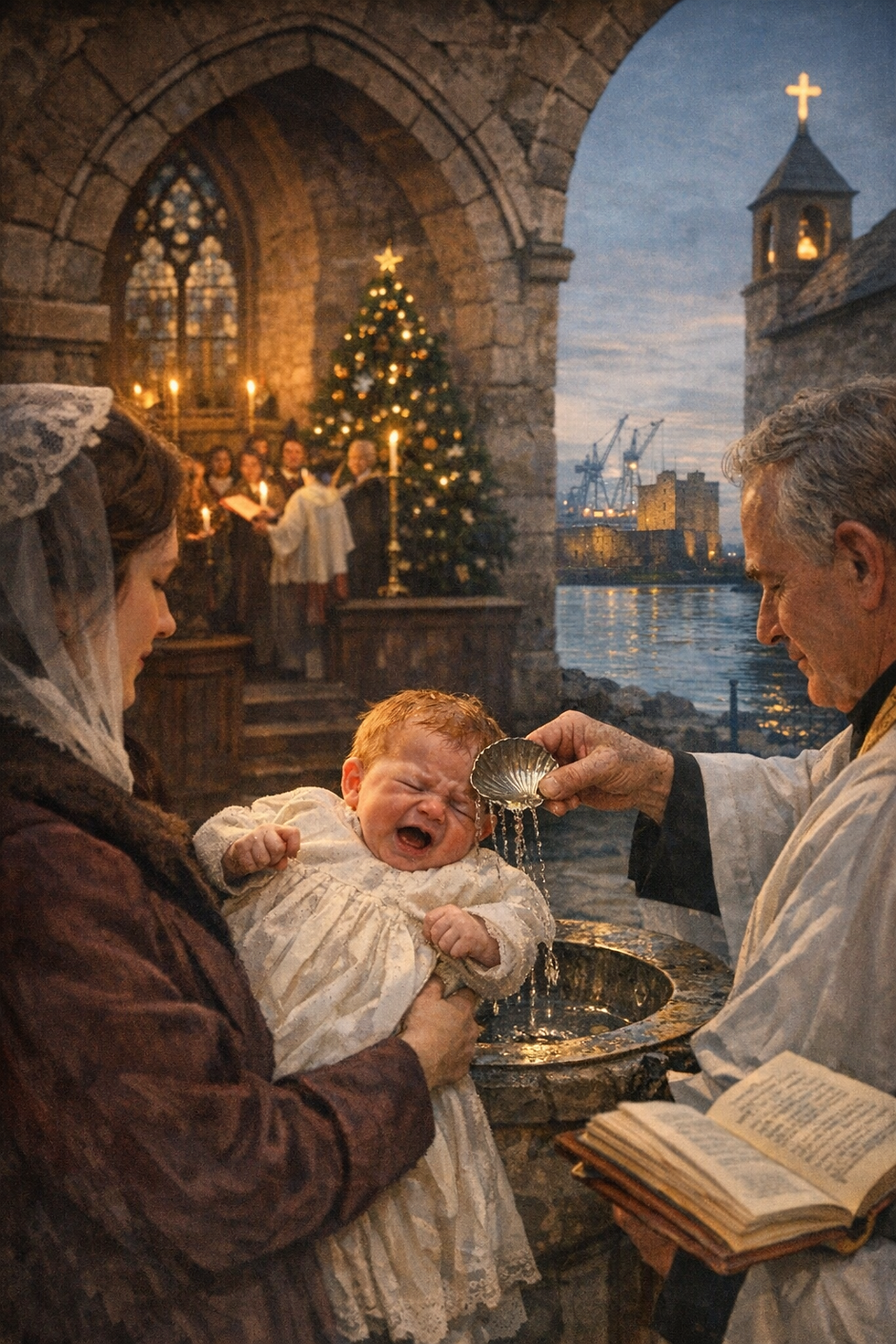
Sir Timothy arrived in this world with what his late mother called “commendable impatience” — an eight-month child already determined to greet Christmas Eve ahead of schedule. He was born amid the salt air of Carrickfergus, the family house gazing steadily across Belfast Lough, while the distant clang of shipyard hammers mingled with carols from St Nicholas' Church. Baptised there at eight days old — indignant, he was told, at the cold — he received a sequence of names long enough to steady a lesser character. If nomenclature shapes destiny, Timothy was fortified early.
Being born
Achievements
Marginalia to Sir Timothy's existence
Inheritance & Echoes
A Legacy in the Lakes
"Though I may have not yet beheld the Holy Grail, many a dragon have I learnt to strike down along my pilgrim’s way.”
Timothy Monday


The Making of a Philologist
At school, littleTimothy was tolerable at sums and formidable at sentences. He annotated margins more eagerly than he completed exercises. Words enchanted him; he pursued their ancestry as other boys pursued cricket balls. When he encountered runes — those stern, angular cousins of our alphabet — he was lost to the modern world entirely. He used to find fuþorc scratched in improbable places. At university in England he studied philology with solemn delight, defending the proposition that letters possess souls. The examiners called it eccentric. We should call it consistent.

The Fellowship of the Scones (and the Swords)
Cricket, and the gentle ache of a love divided by the Irish Sea, took hold of him by the age of twelve.. The match itself perplexed him; the tea interval converted him. He has remained ever since a gentlemanly dabbler — loyal to fellowship, sandwiches, and the moral architecture of the game. In the same years he immersed himself in Arthurian legend, reading Malory until the pages softened and wandering Welsh hills in mist, half-convinced that courtesy might yet conjure the Grail. If he has slain dragons, they have been chiefly interior — though he speaks of them with ambiguous precision.

On Titles and Tenants
He inherited the baronetcy at the age of thirty-two, and accepted it without theatricality, as one accepts a well-worn prayer book: not for display, but for use. After his parents’ deaths he withdrew to Cumbria, to a house overlooking lakes that mirror the heavens with disconcerting accuracy. There he assembled a formidable library and indulged his philatelic passions, eventually becoming a Fellow of the Royal Philatelic Society London. His main house, as we can personally attest, is not empty. It possesses what Timothy calls “resident antiquities.” He does not fear them; he seeks them. A footstep in the corridor, a sigh near the hearth — these, to him, are companions. He maintains, with infuriating calm, that legends do not die, titles do not evaporate, and ghosts, when properly regarded, are merely history refusing to be ignored.
"A Baronet Who Takes Tea with a Lion, while Dragons go the knuckles"
Majesty Magazine
"Sir Timothy is quite the Arthurian figure, really. Very spiritual. Deeply confused. Exactly the sort of person who ought to have heraldry."
Vogue UK
Sir Timothy's Motto:
"Proud to be Confused"

To Sir Timothy, the Red Hand of Ulster is not merely a heraldic emblem, but a small, persistent interruption in the tidy narratives of history.
It is, first, a symbol encountered—on flags, on crests, on the quiet fabric of tradition—before it is ever fully understood. And like all such symbols, it resists a single explanation. There are legends, of course: of a race for land, of a hand cast ashore in desperate claim. But Timothy would not rush to decide which version is true. He would be far more interested in why the story continues to be told at all.
To him, the hand represents assertion at the edge of uncertainty—a gesture made in the absence of guarantees. It is the moment when claim precedes justification, when identity is declared before it is agreed upon. In that sense, it is less about conquest and more about insistence.
There is also something faintly unsettling in it. A hand, severed from the body, elevated to symbol—history reduced to a gesture, and the gesture repeated until it becomes tradition. Timothy would find in that a quiet reminder that heritage is often composed not of complete truths, but of fragments that have endured simply because they were not allowed to disappear.
And yet, he would not dismiss it.
Placed, as it often is, upon a field of white, the red hand does not shout. It remains—open, suspended, neither entirely welcoming nor entirely forbidding. A mark not of conclusion, but of continuation.
In Timothy’s view, it is precisely this ambiguity that gives it its peculiar dignity: not what it explains, but what it refuses to resolve.