
My Pavilion
by Sir Timothy Monday


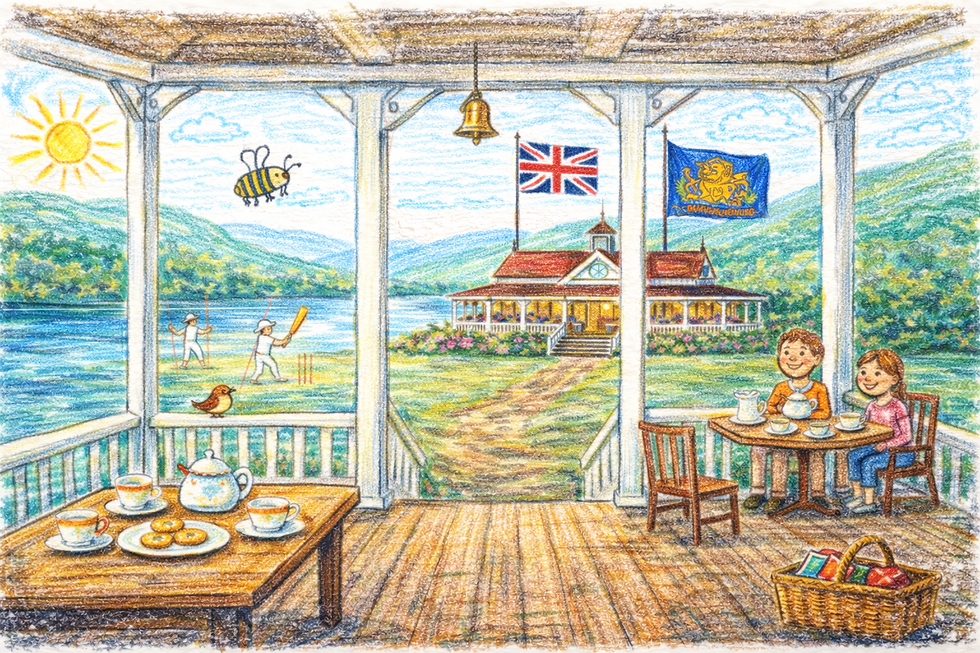
My most gracious thanks to young Eve, whose set of imaginative drawings have lent the Pavilion a charm quite beyond expectation.
I must confess at once that the pavilion was never meant to be important. It was not conceived as a monument, nor as a legacy, nor even—if we are being honest—as a particularly sound investment. It began, as so many of my enterprises do, with a mild irritation and a cup of very decent tea.
I had been standing on the northern lawn of one my Cumbrian retreats, the one nearest to Strandshag Bay, watching a group of young relatives attempting to play cricket with all the enthusiasm of empire and none of the technique, when it occurred to me that there was no proper place from which to observe them. One requires a pavilion in the same way one requires a teapot: not strictly necessary, perhaps, but life without it feels unnecessarily primitive.
So I decided to build one.
The location was obvious. The ground slopes gently towards the lake, which behaves itself most of the time and reflects the hills with a sort of flattering modesty. On clear days you can see the fells dissolving into one another like watercolours left in the rain. The wind comes in sideways, as it should in England, carrying the faint smell of wet grass, old wood, and occasionally defeat.
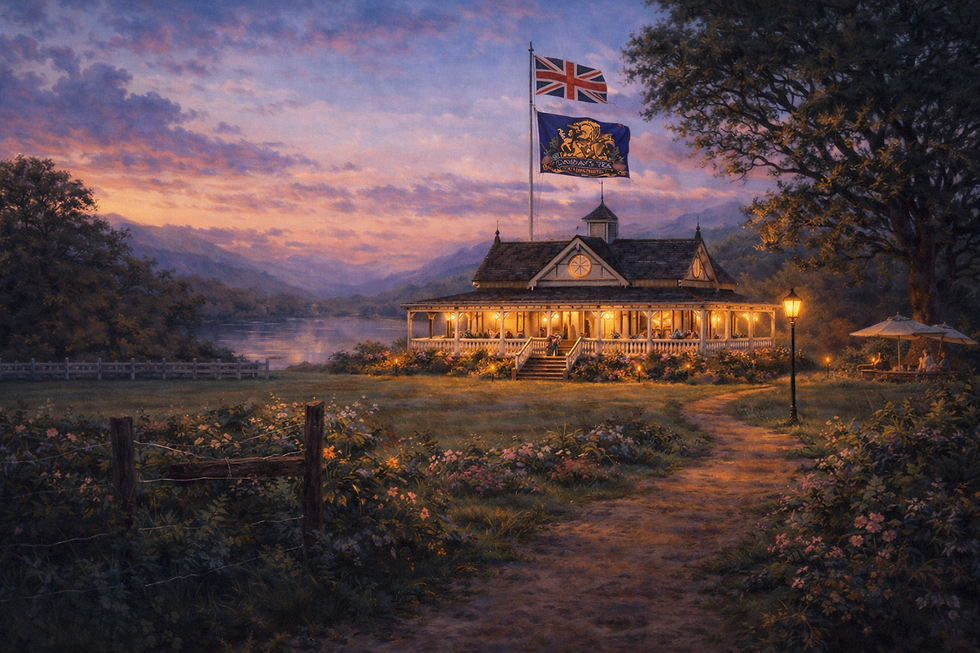
The Pavilion stands on a gentle slope overlooking a modest but immaculately maintained cricket ground. The pitch is aligned east–west, not for technical reasons, but because the late afternoon light falls more poetically on the cover drive that way.
Behind the boundary:
A lake – for reflection, not swimming,
A line of beech trees – for shade and philosophical distance,
And a meadow designated as The Picnic Commonwealth.
No cars are visible from the Pavilion. Guests must approach on foot, which gives them time to remember who they are.
The pavilion itself is deliberately unambitious: white-painted timber, deep veranda, a roof that looks respectable but has no ideological position on modernity. It sits exactly at the midpoint between the pitch and the picnic meadow, which is my way of saying that it mediates between sport and civilisation. Cricket may be the game, but tea is the policy.
At the very top always flies the Union Jack, because I am not an anarchist or a republican. Below it, maybe not smaller, but with no constitutional claims whatsoever, is the flag of Monday’s Tea at the Pavilion Cricket Club. The lion on the emblem is drinking from a teacup, which I consider a fair representation of the institution’s priorities. It is important that the club flag never waves above the national one. Even ambition requires manners.
The building itself is neither large nor small — it is appropriately convinced of its own importance.
Style:
-
late Edwardian,
-
white timber, green trim,
-
wide verandas,
-
deep windowsills designed specifically for teacups.
Inside:
-
one main tea hall,
-
a reading room,
-
a tasting chamber,
-
and what I insist on calling The Archive, although it mostly contains biscuits.
There are no tellies. There is only a bell, and a big screen displayed whenever England is on tour, or Gloucestershire playing a County Championship game.
Inside the pavilion, everything smells faintly of polished wood, and Assam or Bai mu dan . There are long benches for the players, hooks for blazers, shelves for bats, and an entire cupboard devoted exclusively to cups, saucers, and teapots of varying degrees of historical importance. Some of them are antiques. Some of them are just chipped. All of them have been used.
The scoreboards are visible from the veranda, but I rarely consult them. I find that knowing the exact state of the match interferes with one’s ability to enjoy the weather. Officially, the home team is called Monday’s Tea at the Pavilion CC. Unofficially, they are known as “Timothy’s Folly,” which I accept as affectionate.
The picnic area was my addition. The architects had not planned for it, but architects rarely understand hunger. It consists of low tables, gingham blankets, wicker baskets, and a permanent population of scones that appear to regenerate when no one is looking. The teacups on the grass are always full. Empty cups are a sign of moral failure.
On summer afternoons, one can sit there with a pot of Darjeeling or Dimbula, pretending to watch the match while actually listening to the sound of bees negotiating the roses. The lake behind the pavilion provides what I like to call “narrative depth.” It makes everything feel as though it is part of a novel, even when nothing in particular is happening.
Which, truthfully, is most of the time.
The Pavilion is not a café.
It is not a club.
It is not a museum.
It is a ritual engine.
Everything exists to produce three states:
-
Slight hunger
-
Heightened attention
-
Gentle superiority
People do not come to the Pavilion to consume tea.
They come to participate in civilisation
The tea list is not particularly long. It should not be. It is legally restrained.
True Teas Only (with a few tolerated rebellions)
The Holy Trinity
-
Silver Needle
-
White Peon
-
Aged Shou Mei
The Green Constituency
-
Dragon Well
-
Sencha Fukujyu
-
White Monkey — misnamed but forgiven.
-
Jasmine Pearls —scented, not flavoured — I check.
The Oolong Corridor
-
Tieguanyin
-
Da Hong Pao
-
Dong Ding
The Black Parliament
-
Assam Bukhial
-
Darjeeling First Flush —Puttabong
-
Dimbula
-
Nuwara Eliya
The Time Department
-
Sheng Pu-erh
-
Shou Pu-erh
Botanical Concessions
-
Chamomile (for emotional emergencies)
-
Peppermint (for philosophical ones)
This is, I should emphasise, not my main business. Not even close. I have interests in shipping, publishing, mineral water, three mildly controversial museums, and one vineyard that produces a wine no one understands but everyone politely praises. Compared to those, the pavilion is economically irrelevant.
But it is spiritually efficient.
Here, I can conduct meetings on a wide range of topics—cricket, Arthurian lore, Celtic folklore, British cooking and herbalism, Anglo-Saxon runes, the Machin Series, Anglican theology, Bridge, English philology, or History of the English grammar. They never feel like meetings at all. A conversation over tea becomes, by architectural decree, a discussion. A disagreement becomes a debate. A failure becomes “an interesting afternoon.” The pavilion absorbs tension in the way old libraries absorb noise: not by eliminating it, but by civilising it.
Tea is not ordered here.
It is recommended.
A guest is first asked:
-
what they have eaten,
-
what they are reading,
-
and what they are currently worried about.
Only then is tea assigned.
All water is weighed.
All cups are pre-warmed.
If someone asks for sugar, we say:
“We do not interfere with the leaves unless they have personally offended us.”
The cricket ground itself is perfectly respectable, though it has never produced anyone of national importance. The pitch is rolled, the boundary usually marked with small white flags, and the outfield maintained with the kind of obsessive care usually reserved for minor royal children. When a match is underway, especially in mid-summer, I like to watch from a distance with my cane, pretending to analyse the field while actually reflecting on how little any of it matters.
And how fortunate that is.
Cricket is mostly played in the afternoon from May to September, regardless of skill.
The teams are:
-
Monday's Tea at the Pavilion CC — either men’s or women’s, and
-
The Visiting Doubters — usually men, but not always — or The Pavilion’s White Rose Petals — usually (but not necessarily) women.
The rules are classical, except:
-
No one is allowed to argue about LBW.
-
Tea break is mandatory.
-
Anyone who bowls too fast must explain themselves.
The score is recorded, but never published.
Cricket exists here not as competition, but as background justification for tea.
The lake, the hills, the pavilion, the flags, the tea—all of it exists in a state of gentle redundancy. Nothing here needs to be improved. Nothing needs to scale. No investor is waiting for returns. It is a business only in the loosest sense: it produces no profit, but an extraordinary amount of time.
Time to sit.
Time to pour.
Time to watch a ball travel nowhere in particular.
I have often thought that this pavilion represents my true economic philosophy: that civilisation is simply the art of slowing down with better furniture. If the world insists on being efficient, someone must take responsibility for being comfortable.
So I did.
Beyond the boundary lies the picnic area:
-
oak tables,
-
checked blankets,
-
baskets prepared by people who take sandwiches personally.
Typical provisions:
-
cucumber sandwiches,
-
lemon biscuits,
-
fruit cake,
-
strawberries in season,
-
and one mysterious tart no one remembers ordering.
Guests are encouraged to lie on the grass and pretend to be in a novel.
The Pavilion does not sell products.
It sells:
-
belonging,
-
rhythm,
-
and the sensation that time has slowed down in your favour.
There is no Wi-Fi.
There is no hurry.
There is no merchandise except:
-
a tea box,
-
a rulebook,
-
and a stamp.
People leave not with bags,
but with opinions.
The Pavilion exists to preserve one endangered human behaviour:
Sitting down properly.
-
Not scrolling.
-
Not rushing.
-
Not multitasking.
Just:
-
tea in hand,
-
cricket in the distance,
-
lake pretending to be eternal,
-
and the quiet suspicion that, for once, the world is doing exactly what it should.
Which is nothing at all.
The pavilion stands, the tea steams, the flags behave themselves, and the match continues indefinitely. I arrive, I leave, I return again. Other ventures rise and fall, but this one remains gloriously static.
Not important.
Just necessary.