"The Monday Pot"

Sir Timothy´s Cricket Club

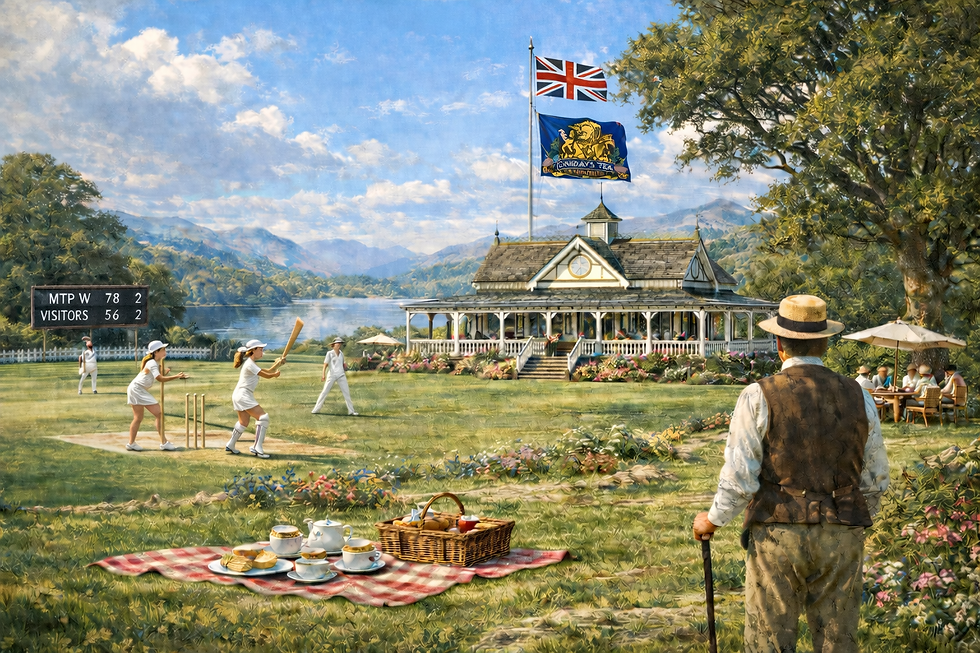







TEA, CRICKET & THE TAMING OF LAKES.
My fairly remote Pavilion in Cumbria, NW England, describes a deliberately unnecessary yet spiritually essential cricket house overlooking a lake in the Lake District. Conceived out of mild irritation and good tea, the pavilion is less a building than a civilising instrument. Positioned between cricket pitch and picnic meadow, it mediates sport and culture. Cricket is played, but tea governs.
The late-Edwardian timber structure houses a tea hall, reading room, tasting chamber, and an “Archive” largely devoted to biscuits. There are no televisions (save for exceptional cricketing circumstances), no Wi-Fi, no hurry. The atmosphere blends polished wood, Assam, and Bai Mu Dan, producing what I call a “ritual engine” designed to generate slight hunger, heightened attention, and gentle superiority.
At its heart lies our cricket club concept: the reknown Monday’s Tea at the Pavilion Cricket Club. The name itself is constitutional—tea as governing principle, the Pavilion as jurisdiction, Monday as philosophy. Matches are secondary to ceremony. Tea breaks outrank wickets by large. No one argues loudly about LBW. Style counts more than runs. Results are recorded in a ledger titled Records of Mild Triumphs and Polite Defeats, but never publicised beyond our walls. Victory is irrelevant; rhythm is everything.
Guests are not served tea here; they are assigned it after mild interrogation. The Pavilion sells no products—only belonging, tempo, and the illusion that time has slowed down in one’s favour.
Economically trivial yet spiritually efficient, the Pavilion stands as my quiet manifesto: civilisation is simply the art of slowing down, properly seated, while cricket happens in the distance.
WHAT IS CRICKET?
Cricket is a sport designed to prove that the British can turn standing still into a competitive discipline and still feel morally superior about it.
Cricket is also an art. The art of waiting for something meaningful to happen, and learning, with great dignity, to accept that it probably will not — yet remaining for tea just in case.
Cricket is memory, as well. The memory of an empire condensed into a field, where time moves slowly enough for everyone to realise it is already over.
WHAT IS JUST NOT CRICKET ?
Cricket is not about winning or losing, but about behaving impeccably while nothing is resolved.
It is what happens when boredom acquires rules, tradition acquires costumes, and disappointment is given a pavilion from which to be observed politely.
For more information about the Laws of Cricket, you can have a look at Lord's.
Or Perhaps, you'd prefer to watch & listen to the Laws, directly explained by my dear friend, Sir Stephen Fry.
A cricket club, I have often thought, is not so much a place where matches are played as it is a quiet agreement between time and memory—where summer lingers a little longer than it ought, and every scorecard is, in its own modest way, an attempt to keep something from gently disappearing.
Timothy Monday


Regarding our “Monday’s Tea Break at the Pavilion Cricket Club”
A Modest Account of a Minor Institution with Disproportionate Consequences.

The home team is, and must always be:
Monday’s Tea at the Pavilion Cricket Club
This is not merely a team name; it is a constitutional statement.
It implies:
-
that tea is not a refreshment but a governing principle,
-
that the Pavilion is not a building but a jurisdiction,
-
and that Monday is not a day of the week but a philosophical condition.
Every match is contested between:
Monday’s Tea at the Pavilion CC
vs.
The Visiting Doubters or The Pavilion Roses
The Visiting Doubters may be:
-
local villagers,
-
wandering academics,
-
lost Australians,
-
Older Employees of important vernacular Tea-Houses, like The East India Tea Rooms Cricket Club, The Ceremonial Teapot XI, the Order of the Silver Samovar CC, The Committee for Proper Steeping, etc.
-
Anyone who has said the phrase “It’s just tea.”
They rarely say it again.
Monday’s Tea at the Pavilion CC plays cricket according to three unwritten rules:
No one appeals loudly.
One raises an eyebrow and lets morality do the rest.
Tea break outranks wickets.
A collapsing innings may wait. A collapsing teapot may not.
Style counts more than runs.
A beautifully timed cover drive for four is worth more than an ugly six that scares the crockery.
The club motto, embroidered discreetly inside the pavilion, reads in Middle English:
“In Infusioun, treuthe”
(In infusion, truth.)
All results are entered into a large leather-bound ledger titled:
“Records of Mild Triumphs and Polite Defeats”
No averages are calculated and sent to Wisden or the Cricket Paper.
No rankings are published.
No one is allowed to remember who won last week.
Because the true purpose of Monday’s Tea at the Pavilion CC is not victory, but:
-
to justify scones,
-
to create pauses,
-
and to provide the illusion that time itself has agreed to play along.
Which, on most afternoons, it does.
Certifications & Distinctions
The Pavilion Declaration of Civility (1893 — Retrospectively Awarded)
Monday’s Tea was formally — though entirely unofficially — credited with “preventing three regrettable sledging incidents and one diplomatic misunderstanding” during a particularly tense village fixture in 2025.
It is widely held that the Darjeeling No. 07, known in Cumbria as "Earl Orlovski" restored good manners before tea and ensured the match concluded in applause rather than arbitration.
Awarded by:
The Royal Society for the Preservation of Sporting Decorum

The First Blend to Influence a Batting Average
A discreet internal study — conducted by a retired statistician and two umpires from the Northern League — concluded that batsmen who consumed Pavilion Assam — known in Cumbria as "HRH Leander Ivanson III black" — before taking guard averaged 12.4 runs more than those who did not.
The findings were described as “statistically charming.”
Awarded by:
The Institute for Applied Refreshment Studies
The Maritime Infusion Medal
Awarded by an official Guild of Maritime Importance, this distinction recognises Monday’s Sea Mist Blend — "Ferdinand Belfort" — as the only tea ever alleged to improve a bowler’s line and length by evoking the rhythm of the tide.
It remains the only infusion to be described in club minutes as “structurally bracing.”
Awarded by:
The Admiralty Guild of Coastal Infusions
Morally Resolute in contests with
The Committee for Proper Steeping CC — against whom Monday’s record remains statistically humbling, though spiritually robust.
“While victories are recorded with gratitude, defeats are remembered with greater clarity — and better tea.”
Bowling Record: Pavilion Catastrophe for the Opposition
Engineer William Tar-Queene, 6 for 18

There are spells of bowling.
There are hostile spells of bowling.
And then there is whatever Engineer William Tar-Queene did that afternoon.
Newly shorn of moustache but not of menace, the Pavilion electrician turned executioner and produced figures of 6 wickets for 18 runs, a return so economical it ought to have come with an itemised receipt.
The Doubters began confidently enough. By the third over, however, Tar-Queene had rearranged their top order with the brisk efficiency of a man rewiring a fuse box. His run-up was practical, unromantic, faintly municipal. His delivery stride suggested infrastructure funding. The ball itself behaved like a memo marked urgent.
First wicket: bowled — middle stump cartwheeling as though it had reconsidered its career.
Second: lbw — the batsman trapped in a moral argument he could not win.
Third and fourth: caught — one by Ppe Good,(who later checked the seam alignment), another by Mines, who claimed she had foreseen it but declined to interfere with fate.
Fifth: a despairing drive to slip, where Loizko lowered himself in instalments and secured the ball with filing-cabinet gravity.
Sixth: clean bowled again — Fernanda removing the bails with noiseless finality, just in case.
Throughout, Alex Pacific nodded gravely at each appeal, as though witnessing a theological demonstration. Chris “Ossie-Toe” Honz was heard muttering that such precision was “clearly engineered.”
The scoreboard flickered in admiration. The Pavilion clock ticked faster. Tea considered an early surrender.
When it was over, Tar-Queene merely adjusted his cuffs and inspected the pitch. The Doubters requested clarification. He provided none.
Six for eighteen.
The lights stayed on. The opposition did not.
Honours& Achievements
Occasional Victors over
Narrow Conquerors of
Briefly Triumphant against
The East India Tea Rooms Cricket Club — most notably in the Fog-Shortened Fixture of 2017 (though records at the Pavilion may show considerably more reflective afternoons than triumphant ones).
The Ceremonial Teapot XI — Brisky Summer 2022 — a single celebrated win achieved after an unusually brisk Earl Grey interval; subsequent encounters have largely favoured the Teapot.
The Order of the Silver Samovar CC — once by three runs and good fortune, on a wicket described in minutes as “philosophically uneven.”
Pavilion Record: The Afternoon Tea Was Cancelled by Fire
Professor Cortelezzi — 251* not out vs Kimi Café

There are afternoons when history clears its throat politely. This was not one of them. This was the day Professor Cortelezzi set the Pavilion gently ablaze and kept batting.
Against East India — who arrived punctual, pressed, and faintly superior — the Professor compiled 451 not out, and in so doing postponed tea by two hours, three committee meetings, and Marianne Ditches’ sacred kettle, which has not quite forgiven him.
Opening the innings, Marianne contributed a brisk 22 before declaring the pitch “under-fermented.” Cortelezzi, already smouldering, merely nodded and advanced.
At the other end, Mines Tarquin Nic Hill offered 33 of geometric elegance, murmuring that the Professor’s timing was “prophetically inconvenient.” Their partnership reached 182 before Mines was bowled attempting to improve destiny.
Then came Jose Good, Pep, who added 14 while discreetly rewiring the scoreboard to accommodate triple digits in the “individual” column. The old clock above the honours board, normally loyal to continuity, began ticking in self-defence.
Alex Pacific contributed a reflective 29 and later described Cortelezzi’s cover drive as “morally persuasive.” He was caught at slip while drafting a footnote.
When Chris ‘Ossie-Toe’ Honz arrived, he whispered that 300 was “a useful distraction.” He made 41 and left abruptly, claiming the field placements were compromised.
By 400, even Loizko had advanced in instalments to offer a steadfast 12, lowering himself between overs like a filing cabinet repositioning for posterity.
Throughout, Roger Countryside kept wicket to East India with noiseless severity, blinking perhaps once.
Tea grew cold. The kettle sulked. The Pavilion committee drafted a formal apology to biscuits everywhere. And Professor Cortelezzi — serene, incandescent, faintly academic — raised his bat at 251*, as though correcting a minor error in the laws of thermodynamics.
East India have requested a rematch. The kettle has requested assurances.
The Day the Wheel Refused to Turn
The Pavilion Innings — 412 for 3

There are scorecards framed in the pavilion of Monday’s Cricket Club that record modest victories, dignified defeats, and the usual arithmetic of Saturdays.
But there is one — written in dark blue ink, in Timothy’s own hand — that records 412 for 3.
It remains the club’s highest total.
And it was not meant to happen.
It happened at home.
Under the timbered balcony — the one that creaks faintly in the second over of any serious contest. The white railings freshly painted. The brass bell polished. The long table laid with linen before the first ball was bowled.
It was not a loud afternoon.
It was precise.
The Collapse Before the Ascent
The opposition — a formidable expatriate side — were dismissed for 168. Respectable. Defended often enough.
Monday’s began poorly.
Two wickets down for 11.
A thick edge. A misjudged pull. Murmurs from the veranda.
It was then that Anto Zed, top order batswoman, lifeguard, cyclist, devotee of immaculate timing, walked in.
Helmet slightly tilted. Sunglasses tucked away.
She did not hurry.
The Record
It still stands: 412 for 3.
But in the pavilion, beneath the framed scorecard, a small brass plate reads:
“Fortune favors the patient.”
And Timothy, when asked about that day, always replies:
“We did not defeat the opposition.
We simply outlasted chance.”
The Origin of the Nickname
No one is entirely certain when the Monday Pot nickname first appeared in the Pavilion.
Some insist it began during a particularly languid club match, when the players had been fielding since morning and morale had begun to resemble a damp scorecard. Sir Timothy, who had been observing events from the veranda with philosophical concern, quietly disappeared into the kitchen.
A few minutes later he returned carrying a stout teapot, a tin of rather promising leaves, and the calm authority of someone who had decided that the afternoon required improvement.
The tea was poured.
It was stronger than usual, warmer than expected, and accompanied—quite without explanation—by a small jar of marmalade and a plate of biscuits that nobody remembered bringing.
Conversation resumed. Field placements were discussed with renewed seriousness. Someone suggested that the bowler looked more dangerous after tea.
From that day forward, whenever the Pavilion kettle was called into service, someone would ask the inevitable question:
“Is the Monday Pot on?”
It has been ever since.
No one claims it improves the cricket.
But it unquestionably improves the afternoon.