Tea, Scripture, and the Architecture of Quiet

There are civilizations which measure themselves by conquest.Others by machinery.Others still by commerce, novelty, and restless acceleration.
Britain, at her finest, measured herself by quieter instruments.
A kettle beginning to sing beyond a half-open study door.The soft collapse of an old leather chair beneath evening weight.The deliberate opening of Holy Scripture while rain travelled thoughtfully across ancient windows.
I have often suspected that the decline of many men begins not with catastrophe, but with the abandonment of ritual.
The modern world prides itself upon liberation from ceremony. Everything must become instantaneous, efficient, stripped of silence, stripped of patience, stripped of reverence.
Men consume information now as armies consume territory — rapidly, mechanically, without contemplation.
And thus they become spiritually famished while remaining intellectually overfed.
Tea and Scripture resist such vulgarity.
One cannot rush either properly.
The preparation of tea imposes order upon the mind. The kettle must boil gradually. The leaves must steep. One must wait. Already the soul has begun recovering from the disease of modern haste.
Then comes Scripture.
Not scanned.Not searched.Not excerpted into slogans.
Read.
Read slowly. Read aloud when possible.Read with pauses large enough for thought to enter.
I have never entirely trusted those who treat the Bible merely as information. The Scriptures were not designed for hurried extraction, but for habitation. One must dwell within them long enough for their architecture to become perceptible.
And architecture is precisely the word.
For the Bible, particularly when encountered through the great English tradition of translation, does not merely communicate doctrine. It constructs atmosphere. Rhythm. Moral gravity. Civilizational memory.
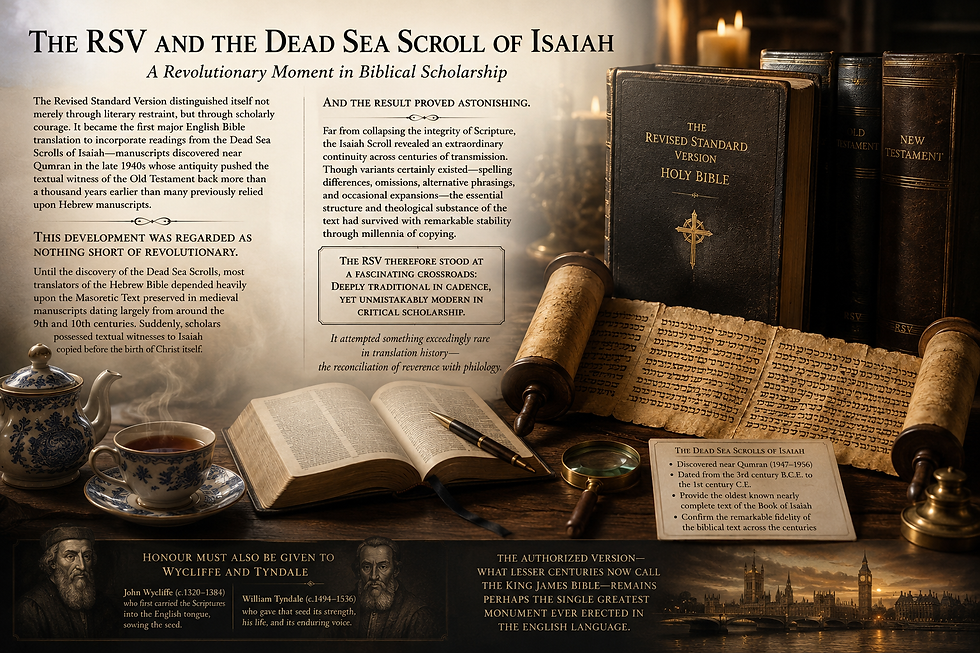
The Authorized Version — what lesser centuries now call the King James Bible — remains perhaps the single greatest monument ever erected in the English language.
Yet honour, if we are civilized enough to remember our debts, must also be rendered to those earlier labourers who prepared the path toward it: John Wycliffe, who first dared place the Scriptures into the cadence of English conscience, and William Tyndale, whose prose burns invisibly beneath the Authorized Version like hidden fire beneath cathedral stone.
Indeed, much of what later generations praise in the King James Bible is, in truth, Tyndale surviving anonymously through centuries.
Not simply because it is sacred. But because it taught the English-speaking world how majesty sounds.
Its cadences possess the movement of cathedral processions. Its silences weigh as heavily as its declarations. Its genealogies advance with the solemnity of dynasties crossing centuries.
One does not merely read it. One enters it.
And yet I must immediately clarify something before the modern spirit begins protesting.
I do not advocate scriptural reading as a species of intellectual tourism. Nor as aesthetic escapism. Nor as the fashionable spirituality of those who quote Ecclesiastes beside expensive candles while understanding neither sorrow nor wisdom.
No.
I speak of Scripture as ritual discipline. As orientation. As the restoration of proportion within a disordered civilization.
There exists, within the Anglican inheritance at its noblest, a profound understanding of this relationship between language, reverence, and inward order.
The Book of Common Prayer understood it. The old parish churches understood it. The candlelit chapels of Oxford understood it. The weathered rectories whose shelves carried both Augustine and cricket almanacs understood it.
To read the Bible properly is not merely to study religion. It is to submit temporarily to a higher tempo of existence.
And tea assists this beautifully.
Indeed, I would venture something dangerously unfashionable:that the English tea ritual may be among the last surviving forms of civilized slowness accessible to ordinary men.
Tea requires neither wealth nor spectacle.Only willingness.
Willingness to stop.Willingness to prepare.Willingness to remain still long enough for thought to recover from fragmentation.
I confess there are evenings when the entire moral condition of modern civilization appears visible in the contrast between two scenes.
In one room: a glowing screen, endless agitation, nervous scrolling, perpetual outrage.
In the other: a lamp, a teapot, an open King James Authorized Version, and silence deep enough for conscience to become audible again.
The latter room is infinitely richer.
And the seasons themselves alter this ritual magnificently.
Winter transforms Scripture into refuge.
During winter evenings, one reads against darkness itself. The windows blacken early.
The house contracts inward. Firelight flickers against bindings worn smooth by generations of hands.
Tea becomes almost sacramental then.
The warmth rising from porcelain while Isaiah speaks of kingdoms collapsing beneath divine judgment.The Psalms sounding more ancient beneath wind and rain.Saint John's
Apocalypse unfolding beside distant thunder.
Winter invites metaphysics.
One feels the nearness of mortality, history, judgment, endurance.The Bible ceases to resemble literature and begins resembling shelter.
Summer, however, performs another miracle entirely.
Then Scripture opens outward.
One reads beneath moving leaves.Windows stand open.The air itself seems participatory.The pastoral imagery of the Gospels becomes immediate rather than symbolic.
The vineyards are no longer abstractions.The lilies of the field no longer decorative metaphors.The sea voyages of Saint Paul seem almost visible upon the horizon of imagination.
Tea changes temperament too.
Winter tea gathers silence.Summer tea gathers memory.
The same cup becomes less defensive, more companionable, almost pastoral.
And perhaps this explains why Christian civilization produced monasteries with
gardens.For contemplation was never intended to reject Creation entirely, but to perceive it correctly.
Now, as to translations.
Permit me to speak plainly.
The Anglican Communion has bestowed upon the English-speaking world several translations of immense dignity, but not all are equal in atmosphere.
The King James Version remains sovereign in majesty.It possesses thunder.Its verses seem carved rather than written.No translation has shaped the English imagination more profoundly.
Yet I also confess admiration for the Revised Standard Version in certain contexts, particularly for sustained study where clarity must accompany solemnity.The English Standard Version, though more modern, occasionally preserves admirable restraint.
But the Revised Standard Version distinguished itself not merely through literary restraint, but through scholarly courage. It became the first major English Bible translation to incorporate readings from the Dead Sea Scrolls of Isaiah — manuscripts discovered near Qumran in the late 1940s whose antiquity pushed the textual witness of the Old Testament back more than a thousand years earlier than many previously relied upon Hebrew manuscripts.
This development was regarded as nothing short of revolutionary within biblical scholarship.
Until the discovery of the Dead Sea Scrolls, most translators of the Hebrew Bible depended heavily upon the Masoretic Text preserved in medieval manuscripts dating largely from around the 9th and 10th centuries. Suddenly, scholars possessed textual witnesses to Isaiah copied before the birth of Christ itself.
And the result proved astonishing.
Far from collapsing the integrity of Scripture, the Isaiah Scroll revealed an extraordinary continuity across centuries of transmission. Though variants certainly existed — spelling differences, omissions, alternative phrasings, and occasional expansions — the essential structure and theological substance of the text had survived with remarkable stability through millennia of copying.
The RSV therefore stood at a fascinating crossroads:deeply traditional in cadence, yet unmistakably modern in critical scholarship.
It attempted something exceedingly rare in translation history — the reconciliation of reverence with philology.
One senses within it the atmosphere of mid-twentieth-century scholarship at its highest form: candlelight replaced by manuscript lamps; ancient prophecy examined not with cynicism, but with disciplined awe.
Still, if one seeks not merely information but encounter — not merely comprehension but atmosphere — the Authorized Version remains unmatched.
Its language slows the reader naturally. One cannot hurry through:
"Though I walk through the valley of the shadow of death..."
without the sentence itself resisting haste.
This matters enormously.
For modern English has become increasingly utilitarian.Functional.Commercial.Thin.
The language of Scripture — particularly Anglican Scripture — preserves verticality.It reminds man that words once aspired upward.
And upward aspiration is precisely what our civilization lacks.
We possess endless communication but little contemplation.Endless expression but little wisdom.Endless opinion but little inward life.
Tea and Scripture together quietly rebel against all this.
They restore hierarchy.Not political hierarchy merely, but spiritual hierarchy.
The recognition that some hours ought to differ from others.That certain rooms should remain quiet.That not every silence requires interruption.That not every thought deserves immediate publication.
I sometimes suspect the old English study — Bible open beside tea service, rain moving across garden stone, perhaps the distant sound of cathedral bells — constituted one of the highest achievements of civilized domestic life.
Not because it was grand.But because it preserved proportion.
A man there remembered that he possessed a soul.
And this, finally, is the true purpose of the ritual.
Not performance.Not nostalgia.Not aesthetic theatre.
Remembrance.
To prepare tea carefully. To open Scripture reverently.To read slowly enough for language to breathe.
These are acts through which the modern individual briefly escapes fragmentation.
One remembers continuity.One remembers mortality.One remembers eternity.
And perhaps, most importantly, one remembers that civilization itself is not maintained primarily by governments or machines, but by millions of small, faithful rituals performed quietly against chaos.
So I encourage the reader:
Choose an evening.Preferably rainy if Providence permits.
Prepare tea properly.Not hurriedly.Not mechanically.
Then take up an Anglican Bible.The Psalms, perhaps.Or Saint John.Or Ecclesiastes.
Read slowly.
Allow the silence between verses to expand.Allow the steam to rise.Allow the world to become temporarily smaller, quieter, more ordered.
You may discover, to your astonishment, that peace was never absent.Only drowned beneath noise.


Comments