Tea on the Pampas: A Brief History of Argentine Cricket
- Timothy Monday, Bart.

- Mar 3
- 12 min read
Updated: Mar 8
I arrived in Buenos Aires on a warm evening that smelt faintly of diesel, roasted coffee, and the river. The Río de la Plata lay somewhere beyond the low horizon, flat and silvery like a forgotten mirror, and I found myself thinking—quite uninvited—that this city had once been imagined, by men very much like me, as a younger cousin of London. There had been a time when one could disembark here and feel that the Empire had not ended, merely changed clothes.
I had come at the invitation of a former British ambassador—retired now, comfortably melancholy, and prone to romantic gestures—who had lured me with the promise of a "North vs South classic contest." It sounded faintly ridiculous, as most things noble do. A cricket match, in Argentina. North against South. Gentlemen in whites, somewhere between memory and fantasy.
And yet here I was, luggage in hand, heart unexpectedly tight.
Cricket in Argentina is not quite dead. That would be too dignified. It exists instead in a state of suspended animation: alive enough to twitch, too frail to breathe on its own. To speak of its "history" is to speak of a ghost that still wears shoes.
The British Dream, Exported
It is often said, with a kind of tragic poetry that seems entirely appropriate, that the very first recorded cricket match in Argentina took place not in a club, not in a school, but in captivity. In 1806, after the failed British invasion of the Río de la Plata, a group of British prisoners that had been caught by the criollos revolutionaries—soldiers who had arrived with muskets and found themselves disarmed by history—were held in the quiet town of San Antonio de Areco, in the middle of the pampas. There, in a moment that feels almost allegorical, they organised what is believed to be the earliest game of cricket ever played on Argentine soil, marking out a pitch not as conquerors but as captives, rehearsing the rituals of home while the Empire itself lay temporarily defeated around them.
Cricket came to Argentina the same way railways did: carried in the trunks of British engineers, merchants, and administrators who mistook permanence for destiny. In the early nineteenth century, long before the great waves of Italian and Spanish immigration reshaped the country, British interests had already begun to colonise something subtler than land: culture.
Railway companies, meat-packing firms, banks, shipping lines—all of them British. The financial arteries of the country pulsed in sterling. One could live for decades in Buenos Aires and speak English more often than Spanish. There were Anglican churches, English schools, afternoon teas with cucumber, and—inevitably—cricket.
The earliest recorded matches date from the 1830s and 1840s, played by expatriates who treated the pampas as a very large and slightly windy version of Surrey. Clubs emerged: the Buenos Aires Cricket Club, the Belgrano Athletic Club, the Rosario Cricket Club. Pitches were rolled. Whites were pressed. Tea was served.
It must have felt, for those men, that cricket was not merely a game but an assertion: a declaration that order could survive transplantation, that one could bring not only machines and money but manners. Cricket, after all, is not about speed or strength. It is about patience, ceremony, time itself. It is an English theory of existence.
And for a while, it worked.
Matches were reported in English-language newspapers. Social calendars revolved around fixtures. Cricket grounds doubled as social theatres where daughters were introduced, marriages negotiated, and the Empire quietly rehearsed itself in miniature.
But even then, something essential was missing.
Football Arrives and Eats the Light
Football, too, arrived with the British. That is the great irony. Both games were imported by the same ships, taught by the same teachers, encouraged by the same expatriate class.
Yet football did something cricket never managed: it escaped.
Cricket remained enclosed, socially and psychologically, within the Anglo-Argentine bubble. It was played at private clubs, behind fences, in English, according to unwritten codes that required not just skill but inheritance. To play cricket was to signal that you belonged to a particular world: Protestant, middle-class, Anglophile, vaguely allergic to improvisation.
Football, by contrast, was contagious.
It required no equipment worth mentioning. No whites. No pads. No tea interval. You could play it barefoot, in dust, with a ball made of rags. It spoke a language that needed no translation. It belonged to everyone and therefore to no one.
Within a generation, football had been appropriated by Italians, Spaniards, criollos, dockworkers, street kids, romantics, anarchists. It became not a British export but an Argentine invention.
Cricket stayed British.
Football became Argentina.
This is the fundamental tragedy of cricket in this country: it never stopped being polite.
The Match I Came to See
The North vs South match was played at a modest ground in the suburbs. Not far, geographically, from where tens of thousands scream themselves hoarse every weekend in football stadiums that resemble open-air cathedrals. Yet here, the atmosphere was closer to a school sports day.
There were perhaps two hundred people in attendance. A few folding chairs. A dog asleep near the boundary rope. Someone pouring tea from a thermos that had seen better decades.
The players were earnest, committed, and visibly aware of their own improbability. Their accents betrayed mixed origins: Argentine Spanish softened by years at bilingual schools, English vowels worn thin by South American sun.
The pitch was dry. The ball didn't swing. The fielders moved with a gentle seriousness that broke my heart.
I realised, sitting there, that this was not sport. It was archaeology.
Why Cricket Failed (And Football Did Not)
People often ask why cricket never caught on in Argentina, as if the answer were technical. Wrong marketing. Bad timing. Insufficient investment.
The truth is deeper, and more uncomfortable.
Cricket demands submission to time. Football defies it.
Cricket teaches you to wait, to endure, to respect process, to accept boredom as moral training. It rewards discipline and punishes improvisation. It assumes that fairness is natural and that institutions deserve trust.
Football does none of this.
Football is chaos with rules. It is injustice embraced. It is the possibility that one moment of madness can undo ninety minutes of logic. It mirrors the emotional structure of Argentine life far more accurately than cricket ever could.
Argentina is a country of crisis, reinvention, broken contracts, sudden ecstasy, and theatrical despair. Football fits this temperament perfectly. It allows for tragedy and redemption within the same afternoon. It is operatic. It is Catholic. It is political.
Cricket is Protestant.
It assumes stability in a nation that has rarely experienced it.
The Social Wall
Cricket also failed because it never truly crossed class boundaries.
Football became the voice of immigrants and workers. Cricket remained the pastime of private schools and gated lawns. Even today, most Argentine cricketers come from the same social strata: bilingual, urban, internationally oriented.
There was never an Argentine Bradman because there was never an Argentine backyard in which cricket felt natural.
Children did not grow up with a bat in their hands. They grew up with a ball at their feet.
And sport, like language, must be learned in childhood or not at all.
The Empire That Forgot Itself
There is another, more painful reason for cricket's stillbirth in Argentina: Britain itself lost interest.
By the mid-twentieth century, the British community began to fade. Economic power shifted. Nationalism hardened. The old clubs aged without renewal. The Empire withdrew its attention elsewhere.
Cricket, abandoned by its own parents, remained in Argentina like a child left waiting at a train station long after the platform has emptied.
Football did not need Britain. Cricket did.
A Game Without a Future
As the match ended—North narrowly victorious, though no one seemed to care—I found myself applauding with an enthusiasm that felt almost rude. The players shook hands, drank beer, discussed technique. There were no journalists. No sponsors. No illusions.
Only affection.
This is the strange dignity of cricket in Argentina: it exists entirely without reward. There is no fame to be gained. No money. No social advantage. To play cricket here is an act of stubborn love.
It is sport as devotion.
And that is why it survives at all.
My Sad Conclusion
Cricket did not fail in Argentina because Argentines rejected it.
It failed because it never belonged to them.
Football succeeded because it was adopted, transformed, corrupted, and finally worshipped. Cricket remained untouched, and therefore irrelevant.
Sitting on that wooden bench, watching a spinner bowl to a batsman who worked as an accountant, I felt something I had not expected: grief.
Not for the game itself, which will survive quite happily elsewhere.
But for the idea that cultures can be transplanted without changing their roots.
Cricket in Argentina is not a sport. It is a memory of an alternative country that never quite existed. A gentler Argentina. A more patient Argentina. A version of the nation that might have believed in time instead of miracles.
Football won because it allowed Argentina to be itself.
Cricket lost because it asked Argentina to become English.
And no country, however hospitable, can survive that kind of request.
When I left the ground, the sun was setting behind the city. Somewhere, a stadium was roaring. Here, the dog was still asleep by the boundary rope.
The game was over.
But it had been beautiful in its failure.
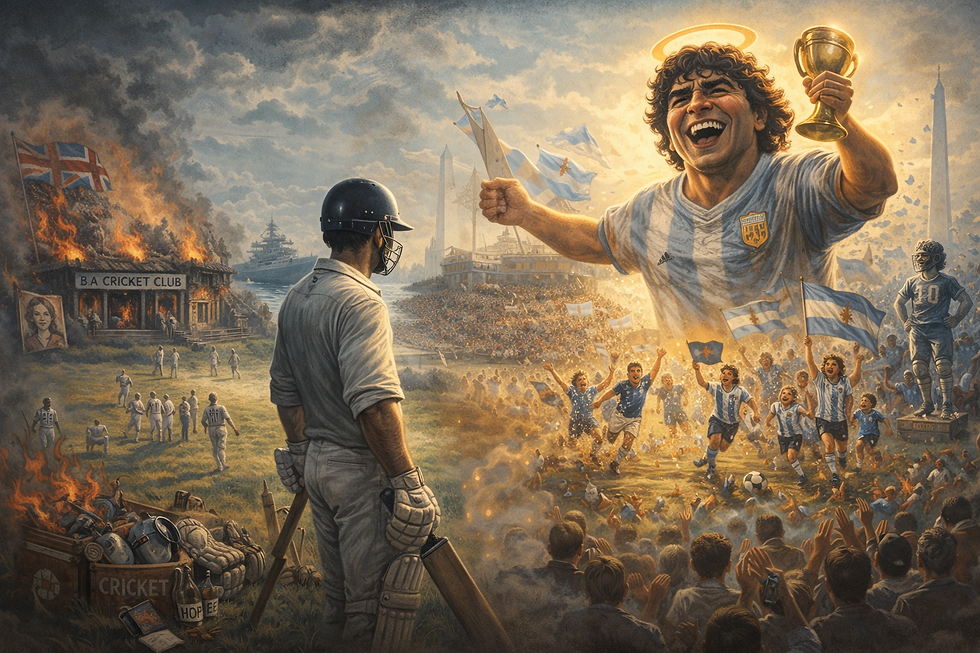
What struck me most, as I read and then re-read these facts in my hotel room in Buenos Aires, was not merely the irony but the almost metaphysical injustice of it all: cricket, that most English of inventions, was in fact the first organised sport played across much of the Americas, arriving earlier than football, rugby, even baseball—like a cultural vanguard that somehow forgot to conquer. In 1877, when England and Australia were inaugurating Test cricket at the Melbourne Cricket Ground, Argentina and Uruguay were already a decade into their own River Plate rivalry, quietly proving that the game had once taken real root here. And yet, as the visionary historian Rowland Bowen observed, even at the highpoint between the wars—when Buenos Aires could defeat touring English sides led by men like Lord Hawke and Plum Warner, and when a combined Argentine-Brazilian-Chilean XI toured England in 1932—the continent stood on the edge of becoming a Test nation and then simply... stepped back into oblivion. Reading Evita Burned Down Our Pavilion by Timothy Abraham and James Coyne, I felt a slow, accumulating grief: this was not just the story of a sport that failed, but of entire societies that brushed past an alternative future—West Indian labourers cutting pitches from jungle in Costa Rica, Chilean nitrate barons patronising clubs, emperors in Brazil and Mexico playing at European civilisation, even the ghostly rumour of Pablo Escobar drifting near a boundary rope—and finally, with brutal symbolism, Eva Perón ordering the burning of the Buenos Aires Cricket Club pavilion, as if the nation itself were formally renouncing the last wooden altar of a forgotten faith. What haunts me is not that cricket died here, but that it once might have lived, and that somewhere between empire and populism, railways and revolutions, South America quietly turned its back on a future it never quite realised it had been offered.
I confess that, the longer I stayed in Buenos Aires, the more my melancholy hardened into something dangerously close to accusation. At first, I had blamed history, temperament, destiny, the usual abstract culprits. But slowly, almost unwillingly, I came to a far more uncomfortable conclusion: cricket in Argentina did not die of cultural incompatibility alone. It was also, quite simply, murdered by the naïveté of its own guardians.
The British invasion of the Río de la Plata in 1806 and 1807 failed militarily, but succeeded in a far subtler way. The cannons were repelled; the customs remained. Through railways, banks, shipping companies and meatpacking plants, Britain performed what might be called a capitalist invasion. English surnames multiplied across the city. Children were born with names like Thompson, Brown, Parish, Banfield. Buenos Aires began, quietly, to dress in tweed.
And among the habits the British sought to transplant—alongside punctuality, social hierarchy, and the peculiar belief that tea could solve moral crises—was cricket. A bat-and-ball game, ceremonial, slow, dignified. For a while, it worked. Native Argentines who had access to elite circles began to watch, to learn, to imitate. Cricket might, in another universe, have become a genuine Argentine sport.
But then came 1867.
And with it, the most catastrophic act of sporting generosity in South American history.
A small group of Britons, intoxicated by novelty, founded the Buenos Ayres Football Club. Football had just been codified in England and was entirely unknown in South America. They wanted to try it. The problem was embarrassingly practical: they had nowhere to play. Their first attempt, scheduled for La Boca, was cancelled because the area flooded. Buenos Aires, like most dreams, turned out to be inconveniently wet.
So they did what seemed reasonable. They asked to borrow the cricket field.
And the Buenos Ayres Cricket Club, with a politeness that history will never forgive, said yes.
Curiously enough, something of the same sort would occur in Britain a few years later. The first official international football match — Scotland vs England (1872 international football match) — was played not in a football stadium but on a cricket ground: Hamilton Crescent, home of the West of Scotland Cricket Club. The match ended in a 0–0 draw before a crowd of some 4,000 spectators.
This was the original sin. The moment when cricket, without knowing it, signed its own death certificate.
On 20 June 1867, near where the Planetario stands today, the first football match in Argentine—and South American—history was played. Eight against eight. Two hours. Red caps versus white caps. Thomas Hogg against Walter Heald. The red team won 4–0, but the score is irrelevant. What mattered was not the result. It was the revelation.
Football was faster. Louder. Dirtier. More physical. Less ceremonial. It did not require silence or tea or inherited codes of conduct. It required only legs, lungs, and a certain willingness to suffer publicly.
It was irresistible.
There were more matches: 29 June, 9 July, and then countless others. Like a virus with excellent marketing, football spread. It escaped the clubs. It crossed class lines. It invaded schools, docks, factories, neighbourhoods. It became, in a few decades, not a British pastime but an Argentine obsession.
Even The Standard, the English-language newspaper that once announced cricket fixtures with paternal pride, admitted in 1912 that cricket would never become the country's main sport. Its explanation was almost comically colonial: that native youth were "aggressive, vehement and impulsive," and therefore unsuited to the "scientific" nature of cricket.
Excuses. Pure excuses.
The truth is simpler and more humiliating: the British tried to impose cricket and accidentally gifted football. They exported a sport and re-imported a religion.
They taught Argentina football, and Argentina turned it into fútbol—with a U—and sent it back, transformed, possessed, and infinitely more alive.
It was a counter-invasion. A cultural boomerang. We took their game and made it unrecognisable. We began at midfield, closely marked, and finished—like Diego Maradona in 1986—by leaving them all behind and placing the ball gently, almost cruelly, into the net.
Cricket, meanwhile, did not realise it was dying. It continued politely. It rented out its field. It welcomed its own executioner. It believed, naively, that history could be shared without being replaced.
Today, Buenos Aires breathes football. It dreams football. It argues football. It processes grief, identity, class, politics and theology through football.
And cricket? Cricket began to die, unknowingly, on that damp afternoon of 20 June 1867, the day it lent its ground to a younger, noisier, less respectable cousin.
The tragedy is not that football won.
The tragedy is that cricket helped it.
And yet—here is where I betray myself—I cannot quite bring myself to end this story with ashes alone.
For all my accusations, for all my bitterness toward those well-meaning, catastrophically naïve gentlemen of the Buenos Ayres Cricket Club, I find that some stubborn, irrational hope still survives in me. It is an entirely English hope, I'm afraid: unrealistic, polite, and founded on the dangerous belief that history might, under the right circumstances, apologise.
Sitting once more in Buenos Aires, watching boys in Boca juggle footballs with the instinct of circus performers, I caught myself imagining something almost heretical: what if cricket returned? Not as a colonial relic, not as a private-school fossil, but as a genuinely Argentine game? What if it escaped the fences at last?
I do not mean filling stadiums or challenging football for supremacy—that would be theological madness. Football here is not a sport; it is a civil religion, with Diego Maradona as both saint and trickster god. To compete with that would be like opening a rival Vatican.
No, my fantasy is smaller, humbler, and therefore perhaps more plausible. I imagine cricket fields next to football pitches, not instead of them. I imagine children learning both: the chaos of the ball at the feet and the patience of the bat in the hand. I imagine cricket spoken in Spanish, shouted in lunfardo, narrated with exaggeration and despair. I imagine Argentine cricket becoming less English and more... theatrical.
I want cricket to abandon its inherited stiffness. To lose its fear of dirt. To embrace injustice, noise, improvisation, and emotional excess. To accept that tea breaks may be replaced by mate, that whites may become dust-coloured, that umpires will occasionally be insulted with operatic creativity.
In short, I want cricket to stop asking Argentina to become England, and instead ask England to forgive cricket for becoming Argentine.
There are signs, faint but real. Development programmes. Bilingual schools opening their grounds. Immigrants from cricketing nations who arrive not with nostalgia, but with energy. The sport still survives in Rosario, in Quilmes, in Córdoba, in those quiet suburban spaces where history has not yet entirely hardened into nostalgia.
My wish—my entirely impractical, deeply Timothy-esque wish—is to help bring cricket back not as memory, but as possibility. To organise matches that matter to people who do not already care. To let the game be loud, flawed, emotional, and slightly ridiculous. To accept that it will never be pure, and therefore might finally become alive.
Perhaps cricket in Argentina does not need resurrection.
Perhaps it needs reincarnation.
Not as an English ghost wandering the pampas, but as an Argentine creature, born late, speaking with an accent, confused about its identity, and therefore perfectly at home.
If football is the country's soul, then cricket could still become its conscience: slower, quieter, less adored, but gently reminding Argentina that not every miracle needs to happen in ninety minutes, and that sometimes—very sometimes—time itself can be trusted.
It is a foolish hope.
Which is exactly why I keep it.


Comments