On the Disappearance of Reverence in Modern Life

Being a Winter Memorandum Set Down After a Certain Rainy Evening in Cumbria.
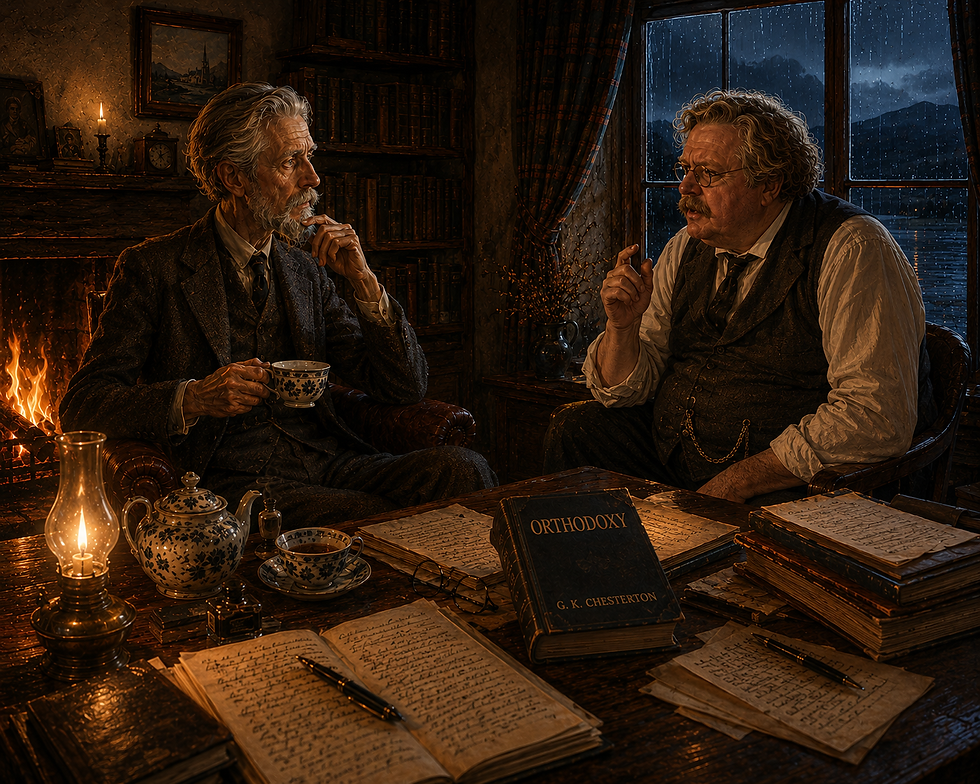
There are nights in Cumbria when the rain ceases to behave like weather and instead assumes the temperament of history itself.
It arrives not as precipitation but as remembrance.
The hills vanish into blackness; the lakes become sheets of hammered lead; the hedgerows lean and whisper under the wind like old parishioners exchanging unpleasant truths after Evensong. On such evenings one feels less an inhabitant of England than a temporary custodian of its exhausted ghost.
It was upon such a night — some years ago now, though not so many that the memory has faded — that the visitor came to my cottage beside the lake.
I had been alone for most of Advent.
The fire had burnt low. The kettle muttered softly upon the stove. Somewhere beyond the windows, invisible sheep were producing the mournful noises sheep make whenever the weather becomes theological. I had before me several loose pages relating to the
Fellowship's manuscript labours, though in honesty I had accomplished little beyond underlining passages and staring with increasing despair at the state of modern church architecture.
I remember thinking — not for the first time — that civilization had somehow survived war, plague, famine, revolution, industrial smoke, mechanized slaughter, and the twentieth century, only to perish at last beneath plastic lighting and cheerful irreverence.
The thought depressed me profoundly.
At approximately nine o'clock there came a knock at the door.
Not a hurried knock.
Not the anxious percussion of a lost traveller.
Rather the deliberate, almost ceremonial knock of a man who still believed doors ought to be approached with dignity.
I opened it.
There stood a vast figure wrapped in an enormous dark coat dripping rainwater onto the stones.
He carried an umbrella of extraordinary melancholy.
His hat appeared exhausted by civilization.
His spectacles glimmered faintly beneath the porch light.
"Good evening," he said. "The weather appears to have embraced Calvinism."
I confess I stared at him.
Not because he seemed frightening.
On the contrary — he possessed the curious familiarity of certain old churches one feels
one has visited before, even when one has not.
He looked less like a stranger than like somebody returning from a very long interruption.
"You had better come in," I said.
"An excellent proposal," he replied gravely. "England was built principally by men deciding not to leave one another outdoors in the rain."
Once seated beside the fire, the visitor removed his gloves with visible relief and accepted tea with almost sacerdotal seriousness.
I have long maintained that tea is among the final remaining liturgies of the English-speaking peoples.
One may judge the condition of a civilization by observing whether it still prepares tea reverently.
The modern world tears packets open like medical technicians dismantling explosives. Water is microwaved. Cups are disposable. Nobody waits. Nobody pours properly.
Nobody permits silence.
Tea has suffered democratization without surviving vulgarity.
My visitor, however, received the cup as though participating in an older rite.
He warmed his hands upon it thoughtfully.
Outside, the rain battered the windows.
"You live alone?" he asked.
"Mostly."
"A dangerous habit for a man inclined toward memory."
"I fear memory has become unavoidable."
"Yes," he said softly. "That is because modernity manufactures forgetfulness professionally."
This struck me at once as the sort of sentence one remembers for years.
I asked his name.
He smiled vaguely into the steam rising from the teacup.
"Oh, names," he murmured. "Names are often less useful than conversations."
This answer would have alarmed me had it been delivered by a thinner man.
Yet there existed in him no theatrical mystery. Only a peculiar tiredness touched with mirth.
The fire crackled.
He glanced toward the manuscripts upon my desk.
"You are a scribe."
"A poor one."
"The poor scribes preserve the world. The confident ones ruin it."
I laughed despite myself.
He continued:
"The modern world believes civilization is preserved by governments, conferences, experts, and systems. This is nonsense. Civilization is preserved by old ladies arranging flowers in churches, by men repairing stone walls correctly, by families keeping photographs, by parish choirs remaining approximately in tune, by bakers taking bread seriously, and by scribes who still believe words deserve decent ink."
I remember looking down at my own hands after he said this.
They seemed suddenly smaller and more tired than usual.
For a long while we spoke of churches.
Or rather:of what churches had become.
The visitor possessed no bitterness. That surprised me most.
He spoke instead with the melancholy amusement of a physician diagnosing a patient
determined to replace his organs with fashionable furniture.
"The disappearance of reverence," he said, "never begins dramatically. It begins with embarrassment."
"Embarrassment?"
"Yes. A civilization first becomes embarrassed by solemnity. Then by beauty. Then by sacredness. Finally by truth itself."
The rain intensified.
I added coal to the fire.
He continued speaking almost absentmindedly:
"People imagine irreverence enters civilization carrying banners and hammers. It does not. It enters apologetically. Smiling. Offering comfort. It says: 'Surely we need not kneel.'
Then: 'Surely sacred music ought to sound more ordinary.' Then: 'Surely churches ought to resemble cafés.' Then eventually: 'Surely man himself is only improved machinery.'"
He sighed.
"The Devil rarely destroys cathedrals. He merely encourages them to become multipurpose halls."
I confess I nearly applauded.
Around ten o'clock the electricity failed.
This improved the evening considerably.
The cottage fell into darkness save for the firelight and two candles upon the table.
The visitor appeared instantly more at home.
"Ah," he said approvingly. "Now the room has recovered its soul."
Outside, the lake vanished entirely into blackness.
One could hear only rain and distant wind.
I asked him whether he believed Christianity was declining irreversibly in England.
"No," he replied at once. "Christianity survives every age because it was founded by God and not by sociologists."
"Yet surely something has been lost."
"Oh yes," he said. "Enormously much."
He leaned back thoughtfully.
"The tragedy of modern civilization is not chiefly that men have ceased believing in God.
It is that they have ceased believing anything deserves reverence at all."
He gestured vaguely toward the shelves.
"Books are no longer treasured but consumed. Meals are no longer shared but optimized. Churches are no longer entered but utilized. Language itself is no longer spoken but deployed."
He smiled sadly.
"The modern world treats existence as administrative material."
I asked him whether this process could be reversed.
"To some extent."
"How?"
"By recovering gratitude."
The answer seemed absurdly simple.
He noticed my expression.
"Yes," he laughed. "Everybody wants dramatic revolutions. But gratitude is the most revolutionary habit remaining."
He pointed toward the kettle.
"A man who thanks God sincerely for tea is already resisting industrial barbarism."
At some point after midnight the conversation turned toward pilgrimage.
This subject animated him considerably.
"Modern man travels constantly," he said, "yet almost never pilgrimages."
"What is the difference?"
"Pilgrimage possesses reverence. Tourism possesses appetite."
I wrote that sentence down immediately.
He observed me doing so with approval.
"A pilgrim understands himself as spiritually small," he continued. "A tourist understands himself as entitled."
The fire shifted softly.
"One walks toward Canterbury, Santiago, Jerusalem, Lindisfarne, or Walsingham not merely to arrive somewhere, but to become morally rearranged by the road itself."
He looked toward the rain-darkened window.
"The modern world cannot understand pilgrimage because it has forgotten sacred destinations."
I remarked that many churches themselves no longer seemed sacred.
"Yes," he said quietly. "That is among the gravest symptoms."
He paused for some time before continuing.
"When reverence disappears, man does not become free. He becomes perpetually amused and spiritually homeless."
That sentence settled upon the room with extraordinary heaviness.
I remember hearing the clock ticking after it.
Toward one o'clock I brought out bread, butter, and a small quantity of marmalade
prepared by an elderly widow from Keswick whose preserves possess near-apostolic authority.
My visitor accepted these with profound seriousness.
Watching him eat was curiously moving.
Not because he ate extravagantly.
Rather because he ate attentively.
Like a man still aware that bread emerged ultimately from miracles.
"The disappearance of reverence," he said between bites, "is visible first in small things."
"How so?"
"A society that mocks table prayers will eventually mock marriage vows. A society
incapable of silence before beauty will eventually become incapable of truth. Irreverence is never merely aesthetic. It is metaphysical."
The candles trembled slightly.
He smiled.
"Civilization survives upon invisible manners."
This struck me as profoundly true.
Modern people speak endlessly about systems while neglecting habits.
Yet civilization depends infinitely more upon habits:
saying grace, lowering one's voice in churches, writing letters carefully, dressing properly for solemn occasions, standing when the dead are mentioned, teaching children not merely information but conduct.
Once such habits vanish, laws become helpless.
At one stage I asked him directly whether he blamed technology.
"Not chiefly."
"Then what?"
"Speed."
He answered instantly.
"Modern civilization destroys reverence principally through speed. Reverence requires lingering. Capitalism, bureaucracy, entertainment, and technology all accelerate existence until contemplation becomes impossible."
He pointed toward my manuscripts again.
"A handwritten page resists speed. That is why your fellowship matters."
I felt embarrassed by the compliment.
He continued:
"When a man copies sacred words slowly, he enters moral rhythm with them. The hand teaches the soul patience."
Outside, thunder rolled faintly over the hills.
The visitor seemed almost pleased by it.
"One should never trust a theology entirely comfortable beneath fluorescent lighting," he added.
Near two o'clock I finally asked him whether he believed modern Christianity had become excessively eager to resemble the world.
"Certainly," he replied. "The Church has repeatedly mistaken friendliness for relevance."
He smiled gently.
"A church should welcome all men. It should not resemble an airport lounge."
I laughed aloud at this.
"The early Christians conquered Rome partly because they possessed mystery, beauty, discipline, sacrifice, and transcendence. Modern churches often attempt conquest through informality and projectors."
He shook his head.
"One cannot out-entertain a civilization dedicated professionally to entertainment."
This, I think, may be among the truest things ever spoken in my cottage.
The rain gradually softened toward dawn.
The room had grown very quiet.
The visitor stared into the embers for some time before speaking again.
"Young people," he said softly, "are not starving for freedom nearly so much as they are starving for meaning."
I nodded.
"They seek reverence instinctively. That is why even the irreligious invent rituals endlessly — wellness ceremonies, ideological liturgies, therapeutic confessions, political orthodoxies. Man cannot survive spiritually without reverence. He merely redirects it toward inferior gods."
He sighed.
"The modern tragedy is not that men worship nothing, but that they worship without holiness."
For a long while neither of us spoke.
I remember feeling then a peculiar grief — not despair exactly, but the sorrow one
experiences upon realizing a beloved house has been neglected for generations.
England herself seemed present in the room somehow:rain-soaked,aged,beautiful,confused,half-forgetting her own prayers.
At last the visitor rose.
The sky beyond the windows had begun to pale slightly over the invisible lake.
"I fear I must go."
"You are travelling onward?"
"Aren't we all?"
He gathered his enormous coat.
I noticed then that the umbrella by the door looked absurdly familiar.
Indeed several things suddenly seemed familiar:the broad outline,the spectacles,the immense warmth,the paradoxical sentences,the cheerfulness resisting melancholy like a candle against weather.
An impossible suspicion entered my mind.
Surely not.
Surely impossible.
At the threshold he paused.
"One last thing, Mr. Monday."
"Yes?"
"Never become ashamed of reverence. The modern world will attempt constantly to embarrass you out of it. Resist politely."
He smiled.
"Civilization depends largely upon stubborn men continuing to treat sacred things as sacred after fashionable people have grown tired of doing so."
Then he stepped into the fading rain.
I watched him disappear along the road beside the lake until mist consumed him entirely.
Only after several moments did I return slowly to the sitting room.
There, upon the table beside the empty teacup, rested a small worn volume I did not recognize.
I picked it up.
Its cover read:
Orthodoxy.
By G. K. Chesterton.
I confess I sat down rather abruptly.
The fire had nearly died.
The cottage remained silent save for the kettle beginning once more to mutter upon the stove like a tired parish clerk preparing Matins for a civilization running late.



Comments