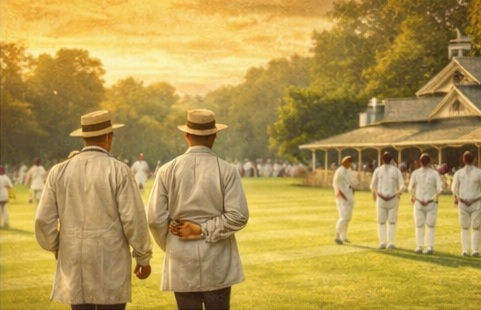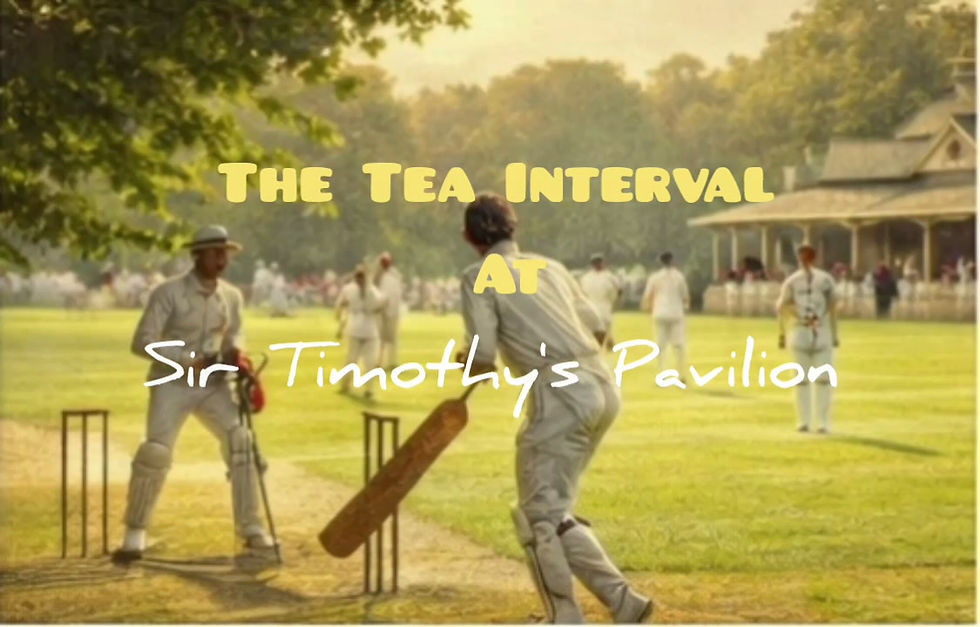
The Tea Interval
There are moments in cricket when the game, having proceeded with admirable seriousness for some hours, remembers that it is also a civilised affair. The sun has moved perceptibly across the ground, the bowlers have grown philosophical, and the spectators—who began the day with military discipline—have become gently reflective. It is then that the umpires call what is known as the Tea Interval.
To the uninitiated, this may sound like a mere pause in play. It is not. It is, in fact, one of the quiet pillars upon which the entire architecture of cricket rests.
In the longer forms of the game—particularly the dignified stretches of first-class or Test cricket—the Tea Interval occurs in the late afternoon, usually around four o’clock. The players leave the field, not in defeat nor triumph, but in a temporary suspension of competition. Bats are rested, boots unlaced, and the field itself seems to exhale.
At that moment the pavilion awakens.
Within its wooden rooms and shaded verandas appear trays of tea, modest sandwiches, slices of cake, and occasionally something more ambitious if the club possesses culinary ambitions. The players take tea, of course, but the interval belongs just as much to the spectators. It is the hour in which conversation replaces applause.
One might hear a gentleman remark upon the virtues of a well-pitched outswinger, or a lady defend the elegance of a cover drive with more conviction than any commentator. Someone invariably claims that the pitch is “doing something interesting,” which in cricketing language can mean almost anything.
The Tea Interval is therefore not simply refreshment. It is reflection.
For cricket, unlike many modern sports, understands that endurance requires punctuation. Without these pauses the game would risk becoming hurried, and hurry is the great enemy of civilisation. Tea restores proportion to the afternoon. A collapse of wickets becomes merely a story; a patient century becomes a matter worthy of calm admiration.
It is long believed that the Tea Interval is one of England’s most successful diplomatic inventions. It reconciles effort with leisure, rivalry with hospitality. A bowler who has spent two hours attempting to dislodge a batsman may, moments later, find himself buttering a scone beside him.
And no war has ever survived the sharing of marmalade.
At Sir Timothy’s Pavilion, we regard the Tea Interval with the reverence usually reserved for cathedral bells. When the hour arrives, the field may fall silent, but the pavilion comes gloriously alive. Cups are poured, preserves are opened, and the conversation—like the tea itself—grows steadily stronger.
Soon enough the players will return to the crease and the match will resume its gentle drama. But for those few minutes the game remembers its true purpose.
Not merely to be played, but to be enjoyed.